Austin ADU Rules in 2026: What HOME Lets You Build, What It Costs, and When the Math Actually Works
Austin ADU rules under the HOME initiative in 2026: what you can build, what it costs, what it rents for, and a worked investor model that shows when the math works.
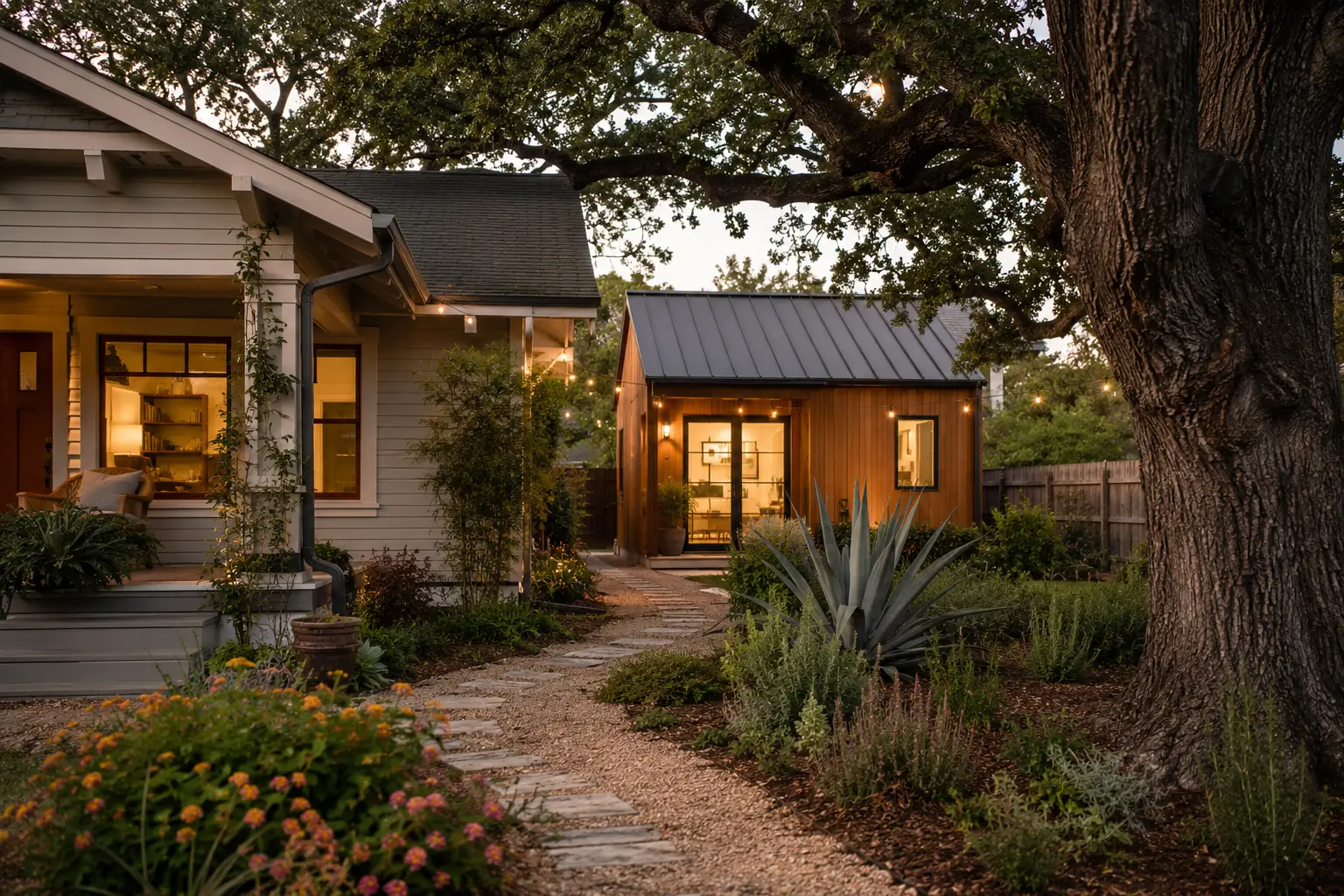
Most of what you will read about building an ADU in Austin was written for the 2021 market. Rents were ripping, the city capped you at 1,100 square feet, and the internet promised that a backyard cottage was a money printer. In 2026, the rules are dramatically better and the rent math is dramatically worse. Both of those things are true at the same time, and if you only know one of them, you are going to make an expensive mistake in one direction or the other.
This guide covers the current rules under Austin's HOME initiative, the real 2026 cost stack from Austin builders, what units are actually renting and selling for right now, and a worked three scenario underwrite so you can see exactly where the numbers land before you spend a dollar on drawings.
What HOME actually changed
The Home Options for Middle-income Empowerment initiative passed in two phases and rewrote the single family rulebook that had been mostly frozen for decades.
Phase 1, adopted December 2023. Up to three housing units are allowed on lots zoned SF-1, SF-2, and SF-3. Tiny homes, defined as dwellings of 400 square feet or less excluding loft space, are now permitted as real housing units instead of being exiled to designated parks. The old cap limiting how many unrelated adults can live together was repealed. Impervious cover limits for these projects were aligned at 45 percent for SF-2 and SF-3 style standards. And because Austin eliminated minimum parking requirements citywide in November 2023, none of these units requires a parking space.
Phase 2, adopted May 2024. The minimum lot size for a single home dropped from 5,750 square feet in SF-2 and SF-3, and 10,000 square feet in SF-1, down to roughly 1,800 square feet under the new Small Lot Single-Family use. Phase 2 also made it far easier to subdivide a standard lot into two or three small lots, each with its own house and its own deed.
The size rules changed shape, not just number. Before HOME, a detached ADU was capped at 1,100 square feet or 0.15 floor to area ratio. That standalone ADU cap is gone. Inside the Subchapter F boundary, the McMansion ordinance still governs the whole project at a 0.4 FAR with a 2,300 square foot minimum allowance, and height still follows the base zoning district. Outside that boundary, FAR limits on these uses largely fall away. Design freedom went up substantially. So did the value of knowing exactly where your lot sits on the map.
The preservation bonus is the sleeper. For structures built on or before December 31, 1960, if you preserve at least 50 percent of the existing dwelling and 100 percent of the street facing facade, the preserved area is exempt from FAR and gross floor area calculations. On a pre-1961 bungalow lot, that exemption is free buildable area that a teardown buyer does not get. Small Lot Single-Family use is not eligible for this bonus, so the play only works on standard lot configurations.
Pre-HOME vs. 2026, side by side
Units per SF-1/SF-2/SF-3 lot
- Before HOME
- 1 home, restricted ADU on some lots
- 2026 under HOME
- Up to 3 units
Detached ADU size cap
- Before HOME
- 1,100 sq ft or 0.15 FAR
- 2026 under HOME
- No standalone cap; 0.4 FAR under Subchapter F where applicable
Minimum lot size for one home
- Before HOME
- 5,750 sq ft (SF-2/SF-3)
- 2026 under HOME
- About 1,800 sq ft (Small Lot use)
Owner occupancy required
- Before HOME
- Effectively yes for many ADU uses
- 2026 under HOME
- No
Minimum parking
- Before HOME
- 1 or more spaces
- 2026 under HOME
- Zero, citywide since Nov 2023
Tiny homes as dwellings
- Before HOME
- Not permitted on SF lots
- 2026 under HOME
- Permitted, 400 sq ft or less
Unrelated adult occupancy cap
- Before HOME
- Yes
- 2026 under HOME
- Repealed
Preservation bonus
- Before HOME
- None
- 2026 under HOME
- Pre-1961 preserved area exempt from FAR/GFA
One thing HOME did not change: private deed restrictions and HOA covenants still control. A city permit does not override a CC&R that prohibits second units, and a 100 year floodplain designation can kill project economics regardless of zoning. Verify both before you pay for architecture.
The 2026 scoreboard: what HOME has actually produced
Two and a half years in, there is finally real data instead of predictions, and it cuts both ways.
Per Austin Development Services, more than 600 applications had been approved under HOME Phase 1 as of May 2026, representing more than 1,200 new housing units built or in the pipeline. Phase 2 is moving slower, with roughly 40 small lot buildings and about half a dozen lot subdivisions advancing as of spring 2026.
The Austin Board of REALTORS released a HOME affordability report in 2026 that gives us the first clean look at what this product sells for. Of the 57 HOME units built and sold in 2025, the median sales price was $750,000. Over the same period, 115 traditional non-HOME homes in comparable areas sold at a median of $1.58 million. HOME product is coming in at roughly half the price and half the size of the traditional single family homes around it.
Units sold
- HOME units
- 57
- Traditional homes
- 115
Median sales price
- HOME units
- $750,000
- Traditional homes
- $1,580,000
Relative size
- HOME units
- Roughly half
- Traditional homes
- Baseline
Read that table the way an investor should. Critics are right that $750,000 is not affordable to a teacher, and ABoR itself pegs the realistic budget for working medic and teacher households near $380,000. But the market is validating small unit product at prices that make backyard construction pencil as a for sale strategy in Austin's central neighborhoods, and that matters more to your underwrite than the affordability debate at City Hall.
The politics are also moving in a builder friendly direction. In May 2026, City Council voted 9 to 1 to direct staff to simplify HOME rules: narrower lot width and side yard requirements, cleaner standards for porches and garages, clarification that two homes fit on a 3,600 square foot lot, and a smoother subdivision process. Those revisions are due back to Council by early December 2026, and staff have been directed to explore extending HOME allowances into areas like the Lake Austin overlay and several Neighborhood Conservation Combining Districts. If you own in one of those overlays, the entitlement conversation on your dirt may be about to change.
What it costs to build in Austin in 2026
Austin builders quote a wide band because the site drives the number as much as the structure. Here is the honest 2026 cost picture, compiled from Austin ADU builders and cost guides published this year.
Garage conversion
- Typical all-in cost
- $80,000 to $150,000
- Per sq ft
- Varies with structure
- Timeline, design to move-in
- 5 to 9 months
Prefab / modular ADU
- Typical all-in cost
- $120,000 to $250,000
- Per sq ft
- $200 to $300 plus site work
- Timeline, design to move-in
- 7 to 10 months
Site-built detached ADU
- Typical all-in cost
- $175,000 to $400,000+
- Per sq ft
- $250 to $500+
- Timeline, design to move-in
- 10 to 18 months
And the line items that ambush first-time builders:
Permits, plan review, and impact fees
- Typical 2026 range
- $3,000 to $15,000
New Austin Water tap and meter, if not sharing
- Typical 2026 range
- $3,000 to $8,000
Electrical panel and service upgrade
- Typical 2026 range
- $3,000 to $5,000
Design and engineering
- Typical 2026 range
- $8,000 to $15,000
Sloped lot or complex foundation premium
- Typical 2026 range
- $10,000+
DSD plan review time
- Typical 2026 range
- Roughly 2 to 4 months inside the timelines above
Real bids reported by Austin homeowners for two story, 1,000 square foot custom units have landed between $375,000 and $400,000 before plans and surveys. If a builder quotes you $180 per square foot all in for a detached unit in 2026, ask very specific questions about what is excluded, because utilities, site work, and fees are usually the answer.
Two cost control notes that survive contact with reality. First, sharing the existing water tap with a private sub-meter is meaningfully cheaper than a new tap, when Austin Water allows it for your configuration. Second, rental grade finishes cost 30 to 40 percent less than designer finishes and rent for nearly the same number. The tenant is paying for a detached unit and a location, not your quartz.
What it rents for: the 2026 problem nobody puts in the brochure
Here is where the 2021 blog posts will hurt you. Austin has absorbed the largest apartment supply wave in its history, with more than 30,000 units delivered in a single year, vacancy near 13.8 percent, and concessions like two months free now common in lease-ups. Every major rent tracker shows the market flat to down.
RentCafe / Yardi Matrix (Aug 2026)
- Metric
- Average apartment rent
- Figure
- $1,638
- Trend
- Down 2.1% YoY
Zumper (Jul 2026)
- Metric
- Median 1BR / 2BR
- Figure
- $1,540 / $2,020
- Trend
- Down YoY
Zillow Rental Manager (Aug 2026)
- Metric
- Average, all types
- Figure
- $1,995
- Trend
- Down $105 YoY, market rated cool
Relocity market report (Apr 2026)
- Metric
- Median, all unit types
- Figure
- About $1,385
- Trend
- Down 4 to 7% YoY by unit type
The one bright spot for ADU owners is the detached premium. Renters consistently pay up to escape shared walls: houses in Austin command a median around $2,400 per month on Zumper's data while the average apartment sits near $1,638. A well located ADU rents like a small house, not like an apartment. In central neighborhoods, realistic 2026 ADU rents run about $1,400 to $2,200 per month for a one bedroom depending on size, finish, and walkability, with two bedroom units above that.
That premium is real. It is also not always enough, which is what the model below is for.
The worked model: one ADU, three ways out
The setup: you already own a central Austin lot zoned SF-3, standard size, outside the floodplain, no deed restrictions. You build a 700 square foot detached one bedroom, site-built at mid-market spec. The budget:
Construction, 700 sq ft at $330/sq ft
- Amount
- $231,000
Design and engineering
- Amount
- $12,000
Permits, reviews, and fees
- Amount
- $6,500
Water/sewer connection, shared tap with sub-meter
- Amount
- $6,000
Electrical service and panel upgrade
- Amount
- $4,500
All-in cost
- Amount
- $260,000 ($371/sq ft)
Scenario 1: Long term rental
Assumptions: $1,895 per month rent, 8 percent vacancy and credit loss in a soft market, self-managed. Property taxes rise because TCAD reassesses when the certificate of occupancy is issued; assume $190,000 of added assessed value at a 1.85 percent effective rate.
Gross scheduled rent
- Amount
- $22,740
Less vacancy and credit at 8%
- Amount
- ($1,819)
Effective gross income
- Amount
- $20,921
Property tax increment
- Amount
- ($3,515)
Insurance rider
- Amount
- ($750)
Repairs and maintenance
- Amount
- ($1,600)
Reserves
- Amount
- ($700)
Landscaping, pest, misc
- Amount
- ($400)
Net operating income
- Amount
- $13,956
Yield on cost
- Amount
- 5.4%
Add 8 percent professional management and NOI falls to $12,282, a 4.7 percent yield. Fund the build with a HELOC at 8.25 percent interest only and the annual interest is $21,450, which means roughly $7,500 of negative carry before you touch principal. In 2026's rent environment, a financed long term ADU on land you bought at full price is a lifestyle decision, not an investment. On land you have owned for years, a 5.4 percent unlevered yield plus long run rent growth and land appreciation is defensible, but it is not the money printer the old articles promised.
Scenario 2: Licensed short term rental
Assumptions: 58 percent occupancy at a $159 average daily rate, self-managed, licensed under the current ordinance. Platforms collect and remit the 11 percent hotel occupancy tax, so it stays out of your operating statement, though you still file the quarterly report with the city.
Room revenue, 212 nights at $159
- Amount
- $33,708
Platform host fees at 3%
- Amount
- ($1,011)
Utilities and internet
- Amount
- ($3,000)
Supplies and turnovers
- Amount
- ($1,800)
STR insurance uplift
- Amount
- ($1,400)
Property tax increment
- Amount
- ($3,515)
Repairs and maintenance
- Amount
- ($2,000)
License and compliance
- Amount
- ($200)
Furnishings, $18,000 amortized over 6 years
- Amount
- ($3,000)
Net operating income
- Amount
- $17,782
Yield on cost
- Amount
- 6.8%
Hand it to a 20 percent STR manager and NOI drops to $11,040, a 4.2 percent yield, worse than the self-managed long term case. The STR premium in this model is really a wage for hospitality work. It gets more interesting after July 1, 2026, which we cover in the next section, because the licensed supply pool just shrank.
Scenario 3: Build to sell under a condominium regime
Texas lets you place two or three units on one lot under a condominium regime and sell them separately with their own deeds, and HOME Phase 2 adds a true fee-simple subdivision path on qualifying lots. ABoR's data shows the market clearing small HOME product at a $750,000 median in 2025. Assume a conservative $415,000 exit for a well finished 700 square foot detached unit in a strong central location, with selling costs modeled at 7 percent.
Exit price
- Amount
- $415,000
Selling costs at 7%
- Amount
- ($29,050)
Build cost
- Amount
- ($260,000)
Condo regime legal, survey, and docs
- Amount
- ($15,000)
Profit before taxes and carry
- Amount
- $110,950
Margin on cost
- Amount
- 40%
This is the trade the professional builders behind those 600+ HOME applications are running. The risks are specific: appraisers are still building a comp set for condo-regime backyard units, some lenders are slower on them, and your buyer pool is thinner than for a standard house. Price accordingly and the margin absorbs it.
ADUs and short term rentals: the 2026 rules just repriced this combo
Austin rewrote its short term rental ordinance after courts gutted the old one. Under the changes adopted in February 2025 and effective October 1, 2025, short term rental became an accessory use allowed in every residential zoning district, provided each unit holds a city license. The old rule that limited ADUs built after October 2015 to 30 rental days per year is gone, even though stale articles still repeating it rank on page one. Licenses are per unit and non-transferable, so a licensed property you buy does not come with its license.
The enforcement hammer arrived on July 1, 2026. Platforms including Airbnb, Vrbo, and Booking.com must now display valid Austin license numbers on listings and remove unlicensed properties within 10 days of a city request, with violations carrying fines of $500 to $2,000 per day. Unlicensed inventory is being squeezed out of the market, which mechanically improves occupancy and pricing power for licensed operators.
Here is the part that matters for this article: separation rules keep short term rentals at least 1,000 feet apart between different sites, but up to two licensed units are allowed on the same lot. A main house plus a licensed ADU is now the densest legal STR configuration in single family Austin. If you have been reading Echelon Property Group's breakdown of the new ordinance, you already know the license process takes weeks, not days, so the sequencing is: permit the ADU, finish it, license both units, then list.
The watch-out list
Before you fall in love with the pro forma, run the kill checklist:
Deed restrictions and HOA covenants
- Why it kills deals
- Private CC&Rs override city zoning; a permit does not cure a prohibition
Floodplain
- Why it kills deals
- FEMA compliance and engineering routinely break the budget
Heritage trees
- Why it kills deals
- Protected trees over 24 inch trunk diameter reshape or shrink the buildable envelope
Utility capacity
- Why it kills deals
- Undersized panels, long service runs, and new taps add five figures
Subchapter F position
- Why it kills deals
- Inside the boundary, the 0.4 FAR governs the whole lot, existing house included
TCAD reassessment
- Why it kills deals
- The new unit is taxed from certificate of occupancy; model the increment, not the old bill
Appraisal gap
- Why it kills deals
- ADU contributory value often appraises below cost in the short run; the exit fixes this, the refi may not
Permit timeline
- Why it kills deals
- 2 to 4 months of review is normal; carry costs during construction are real money
How appraisers actually value an ADU, and why the number is smaller than your invoice
You spent $260,000. The appraiser might credit you $180,000. Understanding why that happens, and what closes the gap, is the difference between a financing strategy and a disappointment.
Appraisers value contribution, not cost. Residential appraisal runs on the sales comparison approach, and an ADU enters the analysis as contributory value: what buyers in your market have actually paid extra for comparable properties with a similar second unit. Your invoice is evidence of what you spent, not what a buyer will pay. Where paired sales are thin, appraisers bracket conservatively, and in a young ADU market that conservatism lands on you. The good news for Austin is mechanical: with 600 plus HOME projects approved and units now closing, the local comp set is compounding every quarter, and contributory values firm up as it does.
The square footage trap. Under the ANSI measuring standard lenders require, a detached ADU's square footage does not merge into the main home's gross living area. Your 2,200 square foot house with a 700 square foot ADU is not a 2,900 square foot house on the appraisal. The ADU is reported separately and adjusted as its own line item. Sellers, and honestly plenty of agents, price ADU properties on blended price per square foot and then act surprised when the appraisal does not cooperate. Price the house and the unit as two components, the way the appraiser will.
Permits are the whole ballgame. A permitted ADU with a certificate of occupancy is a valued improvement. An unpermitted one is frequently credited at zero, and it can do worse than nothing: an appraiser who flags the second unit as a non-legal use can make the property hard to finance at all. This is where HOME quietly did existing owners a favor. Units that sat in a legal gray zone for years are now legal conforming uses on most SF lots, which cleans up both the appraisal and the loan. If your unit predates its paperwork, legalizing it may be the highest ROI project on the property.
The income side finally matters. For decades, appraisers ignored ADU rent on single family assignments because lenders could not use it. That changed. The 2026 financing rules now put a supported market rent, documented on the single family comparable rent schedule, directly into borrower qualification:
Fannie Mae
- ADU rental income treatment
- Allowed on a one-unit principal residence as of the March 2026 DU 12.1 release
- Key limits
- Purchase or limited cash-out refi only; income from one ADU; capped at 30% of total qualifying income
Freddie Mac
- ADU rental income treatment
- Allowed on a one-unit primary residence
- Key limits
- Purchase or no cash-out refi; landlord education required for purchase transactions
FHA
- ADU rental income treatment
- 75% of supported market rent or lease rent
- Key limits
- 50% for a proposed ADU under a standard 203(k); same 30% concentration cap
The practical math most lenders run: 75 percent of the lower of the lease rent or the appraiser's supported market rent, capped at 30 percent of your qualifying income. On our model's $1,895 rent, that is roughly $1,421 per month of qualifying income, which carries about $225,000 of additional loan on a 6.5 percent, 30 year note. For an owner occupant buyer, a property with a rentable ADU is not just worth more, it is affordable to a larger buyer pool, and appraisers are being cautioned to keep that income from being double counted in both the rent schedule and the sales adjustments. The new UAD 3.6 appraisal format, mandatory November 2, 2026, adds structured ADU data fields for the first time, which should make the comp problem measurably better within a few years.
The refi gap, quantified. Take the worked model. You spend $260,000. In a thin comp set, assume the appraiser supports $180,000 of contributory value. At 80 percent loan to value, a cash-out refinance returns at most $144,000 of new borrowing capacity against your $260,000 outlay, about 55 cents of liquidity per dollar spent. That is the appraisal gap in one sentence: the sale exit and the condo regime recover full retail value from a buyer, the refi channel recovers only what the comp set can prove today. Meanwhile the Travis Central Appraisal District has no such hesitation, and will happily tax the new unit at close to its full value from the certificate of occupancy forward. Build with the exit that matches your capital plan.
How to defend the value on appraisal day. Appraisers can only credit what they can support, so hand them the support:
Permits and certificate of occupancy
- Why it moves the number
- Establishes the unit as a legal, valued improvement instead of a question mark
Plans with a square footage breakdown
- Why it moves the number
- Keeps the ADU from being mismeasured or lumped into GLA incorrectly
Current lease and rent comps
- Why it moves the number
- Feeds the rent schedule that now drives qualifying income
Cost documentation
- Why it moves the number
- Cost is not value, but it supports the quality and condition ratings
A list of area sales with ADUs
- Why it moves the number
- Appraisers are expected to use ADU comps when available; make them easy to find
Reconsideration of value, if needed
- Why it moves the number
- Lenders must accept ROV requests; submit specific ADU comps, not complaints
Four theses for 2026
1. The yield goes to whoever already owns the dirt. At 2026 rents, a $260,000 ADU returns about 5.4 percent unlevered. That works as an add-on to land with an embedded low basis. It does not work as a reason to pay full retail for a lot plus construction, unless you are exiting through a sale.
2. Buy entitlement while the market is pricing houses. Austin listings are sitting, sellers are negotiating, and almost none of them price the HOME entitlement into the ask. A 5,750 square foot SF-3 lot is now legally a three unit site, and a pre-1961 bungalow carries a FAR exemption on top. The December 2026 code revisions and the possible extension of HOME into the Lake Austin overlay and the NCCDs are free options you collect by owning before the rules finish loosening.
3. The licensed house-plus-ADU STR combo just got scarcer and stronger. Two licenses per lot, platform-level enforcement purging unlicensed competitors, and platforms remitting the hotel tax. The operators who did the paperwork are being handed market share.
4. Build to sell is the professional trade. A 40 percent modeled margin through a condo regime, with ABoR data showing a real $750,000 median for HOME product, explains those 600+ applications better than any rental spreadsheet does. The buyers exist because $750,000 is what half-price Austin looks like next to a $1.58 million median.
Where Echelon Property Group fits
Most HOME opportunities never hit the MLS as opportunities. They hit it as tired listings, estate sales, and pre-1961 bungalows described by square footage instead of entitlement, which is exactly the kind of inventory covered in our guide to off-market homes in Austin. Echelon Property Group underwrites Austin dirt the way this article does: zoning, overlay position, preservation bonus eligibility, utility reality, and all three exits modeled before an offer goes out. If you want a feasibility read on a lot you own, or a target list of HOME eligible properties in the corridors where the math clears, reach Taylor Sherwood at 512.661.3843 or taylor@echelonpropertygroup.com.
Frequently asked questions
Frequently Asked Questions
How many units can I build on a single family lot in Austin in 2026?
Up to three housing units on most lots zoned SF-1, SF-2, or SF-3 under HOME Phase 1, including tiny homes of 400 square feet or less. Private deed restrictions, floodplain status, and overlay districts can still limit or block projects, so verify at the address level.
What is the minimum lot size for an ADU or extra unit under HOME?
Standard SF-2 and SF-3 lots of 5,750 square feet or more generally support the full three unit allowance. Phase 2's Small Lot rules go down to roughly 1,800 square feet for a single home, and a pending 2026 code revision is set to clarify that two homes fit on a 3,600 square foot lot. Eligibility is address specific, so confirm with Austin Development Services before buying plans.
Do I have to live on the property to build or rent an ADU in Austin?
No. Austin removed the owner occupancy requirement, so investors and non-resident owners can build and lease ADUs.
How much does it cost to build an ADU in Austin in 2026?
Garage conversions run about $80,000 to $150,000, prefab units about $120,000 to $250,000, and site-built detached ADUs about $175,000 to $400,000 or more, typically $250 to $500 per square foot all in. Permits and impact fees add $3,000 to $15,000, and a new water tap adds $3,000 to $8,000.
What does an ADU rent for in Austin right now?
Roughly $1,400 to $2,200 per month for a one bedroom in 2026, with two bedroom units higher. Austin's overall rental market is soft, with vacancy near 13.8 percent and average apartment rents around $1,638, but detached units carry a meaningful premium over apartments.
Can I use my Austin ADU as an Airbnb in 2026?
Yes, with a city short term rental license for the unit. Under the ordinance changes effective October 2025, STRs are allowed in all residential zones with a per unit, non-transferable license, and up to two licensed units can operate on one lot. Since July 1, 2026, platforms must delist unlicensed properties, so license before you list. The old 30 day per year cap on newer ADUs no longer applies.
Will building an ADU raise my property taxes?
Yes. The Travis Central Appraisal District reassesses the property when the certificate of occupancy is issued, and the added value is taxed from that point forward. Model the tax increment on the new assessed value, not your current bill.
Can I sell an ADU separately from the main house in Austin?
Yes, through a Texas condominium regime that gives each unit its own deed, or on qualifying lots through a HOME Phase 2 subdivision that creates separate fee-simple small lots. Both paths add legal, survey, and documentation costs, and condo-regime units can involve extra lender and appraisal friction, so build that into pricing.
Taylor Sherwood is the founder and principal REALTOR at Echelon Property Group in Austin, Texas, with over $155 million in career sales across 200+ transactions, including luxury residential, multifamily, and land development deals across Travis, Williamson, and Hays counties. This article is general information about city code and market data, not legal or tax advice. Verify current rules and fees with the City of Austin before acting.
Continue Exploring
Three places to go from here

ABOUT THE AUTHOR
Taylor Sherwood
Austin Real Estate Advisor · Echelon Property Group
Taylor Sherwood is a Certified Luxury Home Marketing Specialist (CLHMS) and top-performing Austin real estate advisor. He specializes in luxury residential properties, land development, commercial real estate, and investment property across Austin and the Texas Hill Country. With deep market expertise and a results-driven approach, Taylor helps buyers, sellers, and investors navigate Austin's most competitive real estate segments.
Related Reading
Cost Segregation and 100% Bonus Depreciation for Austin Investors: The 2026 Playbook
100% bonus depreciation is permanent. What a cost segregation study does on a $1M Austin STR and an 8-unit, who can use the loss, and what recapture costs.
2026-08-26 • 22 min read
Austin Short-Term Rental Rules in 2026: The Investor's Guide to the New Ordinance, the License Math, and the Shakeout Ahead
Austin rewrote its STR ordinance. License costs, the July 1 platform crackdown, real revenue data from four sources, and a full worked underwrite for investors.
2026-07-31 • 14 min read
Where Austin Homeowners Are Actually Moving in 2026, and How Investors Should Trade It
Travis County just posted its first population decline in over 20 years. County-by-county migration data, the $992/month carrying-cost arbitrage, and four investment theses.
2026-07-28 • 11 min read
Austin Cap Rates in 2026: What Investors Need to Know Before Buying
Where Austin cap rates stand in 2026, how to calculate them, and the underwriting mistakes that sink deals. A practical guide from a local investment broker.
2026-07-07 • 14 min read