Austin Multifamily: Why Institutional Capital Is Still Betting on Central Texas
A clear-eyed read on Austin multifamily in 2026, supply digestion, capital stack distress, submarket divergence, and the basis math behind the best acquisition vintage in a decade.
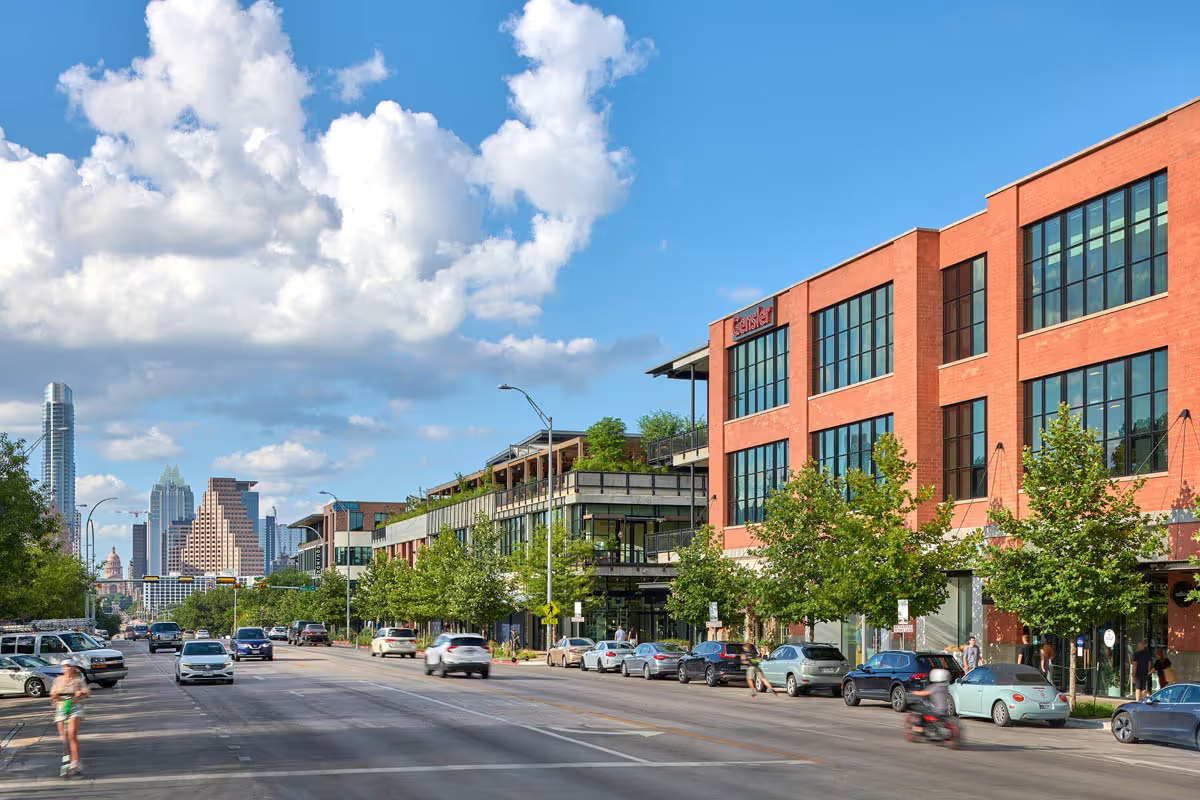
Austin Multifamily: Why Institutional Capital Is Still Betting on Central Texas
For the past 24 months, Austin multifamily has been one of the most argued sectors in commercial real estate.
Bulls point to migration, corporate relocations, and wage growth. Bears point to oversupply, -4.5% rent growth, ballooning concessions, and a refinance wall.
Both sides are right. Both sides are also missing the point.
Austin isn't a binary "boom or bust" story. It's a cyclical repricing event inside a fundamentally strong long-term market. The investors who understand that distinction are the ones quietly building positions right now.
Today's Austin is simultaneously:
- The metro with the largest multifamily supply wave in the country, inventory grew 33% from 2020 to 2025, the fastest rate among major U.S. markets
- One of the strongest long-term demographic stories in the U.S., averaging ~65,000 new residents per year since 2020
- A market experiencing real capital markets dislocation
- And the source of acquisition opportunities that did not exist 24 months ago
For sophisticated investors, this isn't a momentum trade anymore.
It's an underwriting and basis game.
The Supply Wave Was Real. So Was the Demand.
Austin delivered roughly 31,000 units in 2024, a record. Through September 2025, developers completed another 20,311 units, or 6% of existing stock, leading Yardi Matrix's top 30 metros nationally. Total expected 2025 deliveries: around 21,500.
The consequences are well-documented:
- Asking rents fell -4.5% year-over-year in Q4 2025, the steepest decline among major U.S. markets
- Vacancy hit 14.2% in Q4 2025; some new lease-ups are running occupancy as low as 65%
- ~75% of Class A properties are still offering concessions, one to two months free is now table stakes
- Per-unit pricing averaged $224,000 in Q3 2025, well off the 2022 peaks
- Q3 2025 sales volume was just ~$205M, a fraction of pre-2022 norms
That's the bear case. It's not wrong. It's just incomplete.
Here's what the bears miss:
- Austin's employment base grew ~25% from 2020 to 2025
- Tech-related roles (software publishing, IT services, computer systems design) are up 46% in five years
- Q3 2025 marked the first time absorption (5,700 units) outpaced deliveries (3,800) since 2021
- The construction pipeline has collapsed, ~15,900 units under construction at year-end 2025, roughly 65% below the 1Q23 peak
- 2026 deliveries are projected at just 12,000–13,000, a 60% drop from the 2024 peak
This isn't a market with a demand problem. It's a market that ate 31,000 units in 12 months and is now digesting.
The Distress Is in the Capital Stack, Not the Buildings
A huge chunk of today's "Austin multifamily stress" is debt-driven, not operations-driven.
That distinction matters more than any headline gives it credit for.
Many 2020–2022 acquisitions were underwritten with:
- Aggressive rent growth assumptions (6–8% annually in some pro formas)
- Exit cap rates compressed to ~4.5%
- Floating-rate bridge debt at SOFR + 300–400 bps
- Interest-only structures
- 24–36 month refinance horizons that assumed rates would cooperate
When SOFR ripped from near zero in early 2022 to over 5%, debt service reset faster than NOI could compensate. Multifamily values nationally are now off roughly 28% from the 2022 peak, and multifamily delinquency hit 1.37% in Q3 2025, a 12-year high.
In Austin specifically:
- DSCR coverage collapsed on a meaningful slice of 2021-vintage deals
- Sponsors are getting cap-called or refusing to write the check
- "Extend and pretend" is finally ending as debt funds demand fresh equity
- Forced recapitalizations and rescue capital structures are showing up in real volume
The underlying real estate is largely fine. The capital stack isn't.
That gap is the entire acquisition opportunity.
"Austin Multifamily" Is Three Different Markets Right Now
The biggest mistake out-of-state investors make is treating Austin as one market. Submarket divergence has never been wider.
The Domain / North Austin Corridor
Amazon is expanding (330,000 sf of new office, 2,000+ corporate hires). IBM is taking over Meta's vacated 320,000 sf Domain 12 building with a $40M renovation. Five-day return-to-office mandates at Amazon, Dell, and TikTok are anchoring renter demand near major employers. Lifestyle properties tracked by Yardi held stabilized occupancy at 92.8% in August 2025.
East Austin
Land basis is still painful. Going-in yields are compressed. But entrepreneurial value-add and redevelopment plays remain active for groups willing to navigate zoning ambiguity and elevated capex assumptions, see our Austin land development opportunities thesis for more.
Downtown
Concessions are heavy. Lease-up competition is fierce. The executive migration narrative is more muted than 2021, especially with Oracle officially relocating its HQ designation to Nashville (though its Austin presence remains intact). Long term, the land-constrained urban core still wins. Short term, this is a price discovery market.
The Outer Suburbs, Georgetown, Leander, Pflugerville, Kyle, Buda
This is where the institutional money is actually flowing right now. Q3 2025 transactions concentrated in northern suburbs where vacancy hovers near 7% and household formation is outpacing the rest of the metro. Lower basis, stronger workforce demand, more durable cash flow.
The market isn't moving as one block anymore. Pretending otherwise is a great way to lose money.
The Best Acquisition Vintage in a Decade Is Forming Right Now
Pricing psychology has fundamentally reset.
In 2021, deals traded on pro forma. Today, buyers are demanding:
- In-place NOI
- DSCR ≥ 1.25 at current debt costs (5.42% HUD, ~6.75% on 10-year bank fixed)
- Realistic 2–3% rent growth assumptions
- Meaningful replacement cost discounts
- Operational upside, not appreciation prayers
The bid-ask spread crushed transaction volume, Austin investment volume hit just $671M through September 2025, but that's exactly when patient capital wins.
Look at UDR's Q1 2025 play: 300 units at Palo Verde, 96% occupied, acquired at $220K per unit ($65.3M), with an assumed 3.2% fixed-rate agency loan. That deal couldn't have been written in 2022. It writes easily today.
The smart groups are targeting:
- Loan assumption opportunities (most 2019–2021 agency debt sits sub-4%)
- Distressed recapitalizations
- Preferred equity positions in stressed sponsor stacks
- Rescue capital with downside protection
- Below-replacement-cost acquisitions in suburban submarkets
Much of this volume never reaches a broker's website, see how we source off-market real estate in Austin and curate private opportunities for select investor clients.
Why Replacement Cost Is the Most Important Number Right Now
Austin apartment construction costs ran $225–$410 per square foot in 2025, with downtown Class A on the high end and suburban garden-style on the low end. Land, labor, insurance, and permitting timelines have all reset higher and stayed there.
Meanwhile, Class A assets are trading near $200K–$224K per unit, frequently 15–25% below replacement cost on a like-for-like basis.
That spread is the single most defensible long-term thesis in this market.
If you can buy below replacement cost in a metro with:
- A construction pipeline down 65% from peak
- Employment up 25% in five years
- Population projected to reach 5.2M by 2060
- 2026 deliveries projected at 12–13K vs. 31K in 2024
…you don't need rent growth heroics. You need patience.
The Boring Stuff Wins From Here
Texas property taxes are still the silent killer most newer investors underwrite incorrectly. Reassessment risk on a 2021 basis can wipe out three years of NOI gains. Sophisticated operators are spending real money on:
- Tax appeal strategy and protest pipelines
- Insurance carrier shopping (premiums are up 30–50%+ across the metro)
- Operating expense discipline at the line-item level
- Property management performance, not just collection
The era of "buy anything and ride appreciation" is over.
Execution is the entire alpha now.
Institutional Capital Never Left. It Just Got Pickier.
Despite the headlines, REITs have doubled their share of multifamily purchases, from 3% in 2023 to 6% in 2025. Family offices, sovereign capital, and private equity remain at the table. They're just demanding:
- Further repricing
- More refinance distress to clear
- Sub-replacement-cost basis
- Disciplined operators on the GP side
Long-term conviction in Austin among sophisticated capital remains extraordinarily high. The difference between 2021 and 2026 is that today's buyers are running real math, the same discipline we apply across our broader Austin commercial real estate advisory.
The Next 24 Months Will Define the Next Decade
Historically, the best-performing multifamily vintages come out of cycles like this one, not the euphoric ones.
Austin in mid-2026 sits at a rare intersection:
- Long-term demographic strength
- Short-term operational pressure easing (deliveries down 60% from peak, absorption outpacing supply)
- Capital markets disruption creating motivated sellers
- Replacement cost economics favoring acquisition over development
That combination doesn't show up often.
The winners over the next cycle won't be the most aggressive groups. They'll be the ones with disciplined underwriting, real liquidity, operational infrastructure, patient hold horizons, and deep local market intelligence.
Austin's multifamily story is no longer speculative growth.
It's institutional real estate.
And the market is finally behaving like it.
If you're underwriting Austin multifamily acquisitions, looking for [off-market opportunities](/off-market-real-estate-austin), or want to talk through where the basis math actually pencils in this cycle, [reach out directly](/contact), or explore our broader [investment advisory practice](/invest).
Continue Exploring
Three places to go from here

ABOUT THE AUTHOR
Taylor Sherwood
Austin Real Estate Advisor · Echelon Property Group
Taylor Sherwood is a Certified Luxury Home Marketing Specialist (CLHMS) and top-performing Austin real estate advisor. He specializes in luxury residential properties, land development, commercial real estate, and investment property across Austin and the Texas Hill Country. With deep market expertise and a results-driven approach, Taylor helps buyers, sellers, and investors navigate Austin's most competitive real estate segments.
Related Reading

Cost Segregation and 100% Bonus Depreciation for Austin Investors: The 2026 Playbook
100% bonus depreciation is permanent. What a cost segregation study does on a $1M Austin STR and an 8-unit, who can use the loss, and what recapture costs.
2026-08-26 • 22 min read
Austin ADU Rules in 2026: What HOME Lets You Build, What It Costs, and When the Math Actually Works
Austin ADU rules under the HOME initiative in 2026: what you can build, what it costs, what it rents for, and a worked investor model that shows when the math works.
2026-08-07 • 16 min read

Austin Short-Term Rental Rules in 2026: The Investor's Guide to the New Ordinance, the License Math, and the Shakeout Ahead
Austin rewrote its STR ordinance. License costs, the July 1 platform crackdown, real revenue data from four sources, and a full worked underwrite for investors.
2026-07-31 • 14 min read

Where Austin Homeowners Are Actually Moving in 2026, and How Investors Should Trade It
Travis County just posted its first population decline in over 20 years. County-by-county migration data, the $992/month carrying-cost arbitrage, and four investment theses.
2026-07-28 • 11 min read