Exclusive Listing Access Difficulties: Why Luxury Buyers Miss Austin's Best Properties
A significant portion of Austin's luxury transactions occur quietly through agent networks before ever reaching Zillow or the MLS. Here is why the best properties stay private, what barriers prevent buyers from accessing them, and how to change your position in that equation.

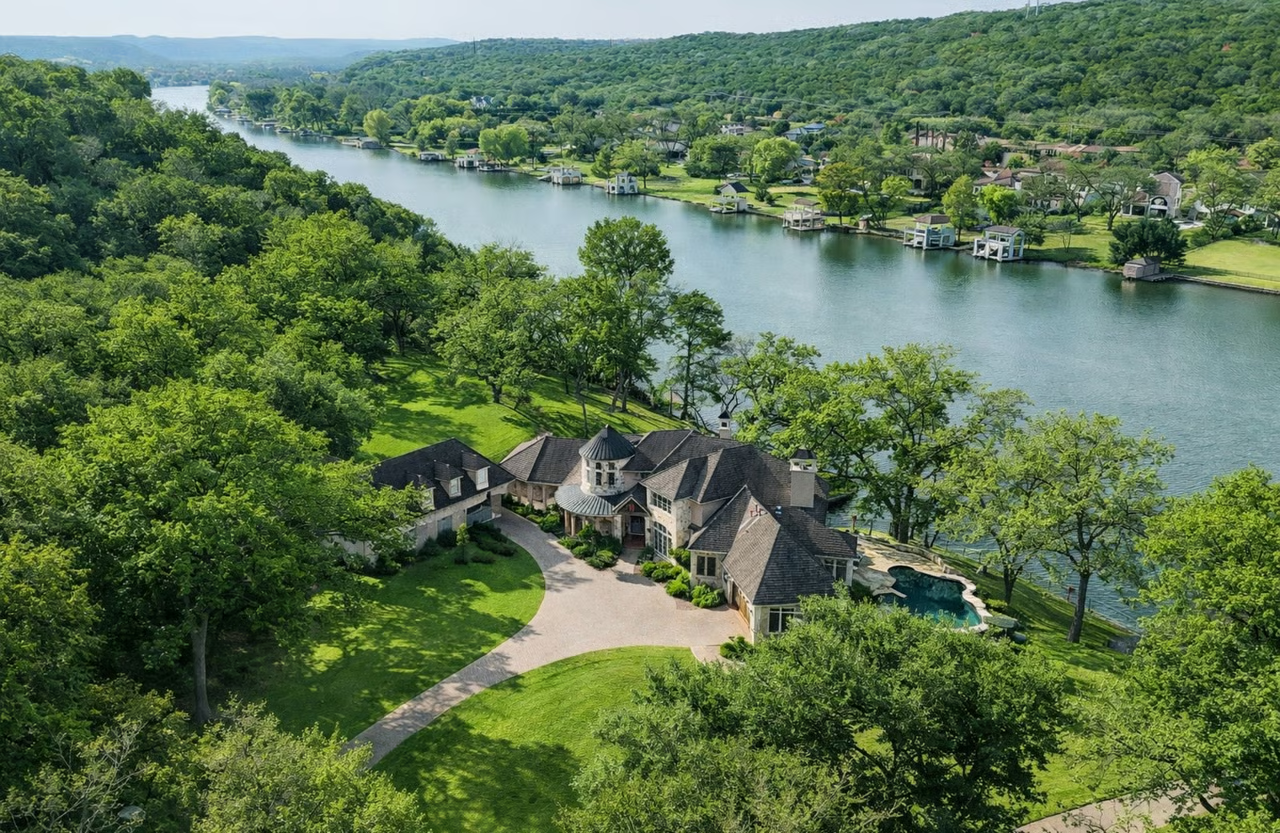
A private Lake Austin waterfront residence at sunset. Many of Austin's most desirable properties trade quietly through agent networks, never appearing on public platforms.
Exclusive listing access difficulties are one of the defining realities of Austin's luxury real estate market. A meaningful share of the most desirable properties in Westlake Hills, Tarrytown, Rollingwood, Barton Creek, Rob Roy, and along the Lake Austin waterfront never appear on Zillow, Homes.com, Realtor.com, or even an active MLS search. They are transacted quietly through agent networks, often before any public marketing begins.
For buyers relying on public platforms, that produces a search that feels perpetually incomplete. The inventory visible online is a partial picture of what is actually trading. Closing the gap between what is visible and what is available is rarely a budget problem. It is a relationship problem, a preparation problem, and a representation problem.
This article explains how Austin's private luxury market actually functions, the structural barriers that prevent most buyers from accessing it, what we observe firsthand in transactions above certain price thresholds, and what serious buyers can do to change their position in that equation.
Why the Best Austin Properties Rarely Appear on Zillow
The public MLS is a useful tool. It is not a complete picture of the market. In Austin's luxury segment, a meaningful portion of transactions occur before, or entirely outside of, any public listing. Understanding why requires understanding what sellers at this level actually want from the process.
Luxury sellers in Barton Creek, Rob Roy, Westlake Hills, Rollingwood, and along the Lake Austin waterfront corridors often have legitimate reasons to avoid broad public exposure. Privacy is one. Executives, founders, athletes, and high-profile individuals who own property in these neighborhoods frequently prefer that their sale not become a public event. Controlling who walks through the home is another. A traditional listing with open houses and unvetted showings introduces disruption that many sellers at this level simply don't need to accept.
There is also a pricing strategy dimension. Testing the market privately before committing to a public list price gives sellers information without the reputational cost of a public price reduction. A property that sits on Zillow with multiple price drops carries a stigma. One that trades quietly at a negotiated price does not.
It helps to clarify the terminology here, because buyers often use these terms interchangeably when they mean different things.
Pocket listing. A pocket listing is a luxury property represented by a listing agent but marketed only within that agent's professional network. It is not published on the MLS or to public portals like Zillow, and is shown only to vetted buyers introduced by trusted agents.
Off-market sale. An off-market sale is a real estate transaction completed entirely without any MLS involvement or public marketing. Buyer and seller connect through a private channel, and the deal is negotiated and closed before any record appears, typically becoming visible only when the deed is filed.
Coming-soon listing. A coming-soon listing is a property registered in the MLS system but not yet activated for public showings. During this short window, agents with strong relationships can surface the property to qualified buyers before broader exposure begins.
Private market inventory. Private market inventory refers to the full set of luxury properties available for sale through agent networks but not visible on Zillow, Homes.com, Realtor.com, or active MLS searches. In Austin's upper tier, this category includes pocket listings, off-market sales, coming-soon listings, and informally tested properties that may never be formally marketed.
Each of these represents a different level of access difficulty, and each requires a different kind of relationship to reach. The coming-soon window is the most accessible but also the most time-compressed. The true off-market sale is the hardest to find and the most relationship-dependent.
What all four have in common is that they are invisible to buyers who are simply browsing public platforms. You cannot search your way into these properties. You have to be brought to them. Buyers who want a clearer picture of what private listings mean in practice will find the distinctions matter considerably once a real opportunity surfaces.
The Real Barriers to Accessing Exclusive Listings
Buyers who struggle with exclusive listing access in Austin typically run into one or more of three structural barriers: relationship access, buyer credibility, and timing. Understanding each one clearly is the first step toward addressing them.
Relationship access is the most foundational. Austin's luxury market operates through agent-to-agent networks that have been built over years of transactions. When a listing agent in Tarrytown or Rollingwood has a seller who wants a quiet, controlled process, they reach out to the handful of buyer's agents they trust to bring serious, qualified clients. If your agent is not in that network, the call does not come. It is not personal. It is simply how private markets function.
This is why working with a generalist agent who primarily searches the MLS creates a structural disadvantage in this segment. Their network may be wide but shallow. The relationships that matter in Barton Creek, Rob Roy, or on the Lake Austin waterfront are specific, and they are earned through repeated, successful transactions in those exact submarkets. Understanding the difference between a luxury agent and a true luxury advisor is often what separates buyers who access private inventory from those who don't.
Buyer credibility is the second barrier, and it is one that surprises some buyers. Having the financial capacity to purchase a property is necessary but not sufficient in a private transaction. Sellers' agents routinely screen buyers before granting access to their clients' homes. They want to know that proof of funds or pre-qualification is already in order, that the buyer has clear and committed purchase intent, and that the person being brought through the door is genuinely ready to transact.
A buyer who is still in exploratory mode, who hasn't assembled their financial documentation, or who cannot clearly articulate what they are looking for will often be deprioritized in favor of a buyer who arrives fully prepared. In a private transaction, the seller is doing the buyer a favor by allowing access at all. That dynamic shapes how sellers' agents evaluate who gets in the door.
Timing is the third barrier. Off-market and pocket listing opportunities move quickly. A property surfaced through a private network may have a window of days, not weeks, before the seller decides to go public or accepts an offer. Buyers who are not ready to act, who need additional time to arrange financing or align decision-making among family members, frequently miss these windows.
The compounding effect of all three barriers is significant. A buyer without strong local representation, without financial documentation ready, and without the ability to move quickly is effectively excluded from the private market regardless of their budget.
How Austin's Luxury Market Structure Creates Information Asymmetry
In most traditional markets, information is relatively democratized. Listings appear publicly, buyers can research them independently, and the playing field is reasonably level. Austin's luxury segment does not function this way. It operates more like a private network than a traditional marketplace, and that distinction has real consequences for buyers who arrive without local context.
Low inventory and sustained demand in Austin's upper tier have intensified this dynamic. When there are fewer available properties than qualified buyers, sellers gain leverage over the process. They can afford to be selective about how and to whom they sell. That selectivity naturally flows through the agent network, reinforcing the information gap between connected and unconnected buyers. Tracking Austin luxury inventory trends makes clear how consistently tight supply has been at the upper end of the market.
Relocation buyers face compounded disadvantages here. Austin has seen consistent inbound migration from California, New York, and Chicago over the past several years, and many of those buyers arrive with significant financial resources but no local market familiarity. They may have worked with excellent agents in their home markets. Those relationships do not transfer. An agent with deep knowledge of Pacific Heights or the Upper East Side has no standing in the Barton Creek, Westlake Hills, or Tarrytown agent communities, and that lack of standing translates directly into reduced access.
Relocation buyers also tend to underestimate how much local market knowledge matters in the evaluation process. Understanding what a property on Lake Austin waterfront is actually worth, how it compares to recent private transactions in the corridor, and what the negotiation dynamics look like requires granular, current, local data. That kind of knowledge is not available on Zillow. It lives with advisors who are actively working those markets. Buyers purchasing a luxury home from out of state face a steeper learning curve precisely because this local context takes time to build.
It is worth noting that recent industry changes to how buyer agent compensation is structured and disclosed have added another layer of process to navigate. The substance of the access problem, however, predates any of that. Information asymmetry in Austin's luxury market is a function of relationships and inventory dynamics, not paperwork.
The net effect is significant. Buyers with strong local representation see a materially different version of the Austin market than buyers who are searching independently or working with advisors who lack deep neighborhood-level relationships.
What We See in Austin's Private Market
A few patterns are consistent in our work across Westlake Hills, Tarrytown, Rollingwood, Barton Creek, Rob Roy, and the Lake Austin waterfront.
In our experience, buyers searching above certain luxury price points often underestimate how much inventory changes hands through private conversations before public marketing begins. The higher you go in the Austin market, the smaller the percentage of relevant inventory you can expect to find on a public portal at any given moment. By the time a property is actively listed, a meaningful number of serious buyers in our network have already evaluated it or passed.
We regularly see properties trade between two introductions and one negotiated offer, with no sign rider, no MLS history, and no public price reduction. We also see the opposite pattern: a property quietly tested at a price the seller is unwilling to drop publicly, then withdrawn before it ever appears as a formal listing. Buyers searching only Zillow would never know either property existed.
The buyers who consistently transact well in this environment share a few traits. They engage representation early, before they have a property in mind. They are clear about what they want and direct about what they will not consider. They have their financial position documented and ready before the first conversation. And they treat their advisor as a strategist, not a tour guide.
The buyers who struggle tend to do the opposite. They wait until they have spotted a public listing they like, assume the MLS reflects the available market, and approach private opportunities as exceptions rather than the norm. In the upper tier of Austin real estate, private inventory is closer to the rule than the exception.
What Buyers Can Actually Do to Improve Their Access
The good news is that exclusive listing access difficulties are not permanent conditions. They are the result of specific gaps that can be addressed with the right preparation and the right representation.
The most important step is also the most straightforward: engage a hyper-local luxury advisor before you are ready to make an offer, not after. Many buyers make the mistake of treating agent engagement as something that happens once they have found a property they like. In the private market, that sequence is reversed. Your advisor needs to know your criteria, your timeline, and your financial position well in advance so they can be actively working their network on your behalf. Properties in this segment are not found. They are surfaced. Understanding how to access exclusive home inventory starts with this shift in approach.
Getting your financial documentation in order early is equally important. In a private transaction, a buyer who can present proof of funds or a fully executed pre-qualification letter at the first conversation is a fundamentally different prospect than one who says they can get it together in a few days. Sellers' agents are evaluating buyer readiness constantly, and the signal you send in that first interaction shapes whether you are brought back for serious consideration.
Be specific about what you are looking for. Advisors can proactively match buyers to properties that haven't been listed yet, but only if they understand the criteria clearly. A buyer who says they want something "nice in Westlake" gives their advisor very little to work with. A buyer who articulates that they want a single-story property on a minimum half-acre lot in the Eanes ISD boundary, with a specific price ceiling and a preference for a pool, gives their advisor a profile they can actively shop through their network.
Prioritize relationship depth over breadth. Working with an advisor who has genuine, established relationships with listing agents in your target neighborhoods is worth more than working with a high-volume generalist who will simply search the MLS and schedule tours. The question to ask is not how many transactions they have closed. It is whether the listing agents in Barton Creek, Rob Roy, Tarrytown, and along the Lake Austin waterfront know them, trust them, and would call them first with a private opportunity.
Buyer positioning also matters in ways that go beyond financial readiness. Sellers in private transactions want certainty. They are choosing to work outside the public market specifically to avoid uncertainty, disruption, and the risk of a deal falling apart. A buyer who arrives vetted, prepared, and with a clear decision-making process is a more attractive counterparty than one who is still weighing options. How you are presented to a seller's agent, and how you conduct yourself through that early process, directly affects whether you are taken seriously.
The Seller's Perspective: Why Exclusivity Is a Strategy, Not an Obstacle
It is easy for buyers to experience the private market as a closed door. Understanding why sellers choose limited exposure makes it easier to approach these transactions with the right mindset, and to see that the exclusivity often creates genuine opportunity for qualified buyers.
For many luxury sellers in Austin, choosing a private transaction is a deliberate strategic decision, not a default. Privacy is the most common driver. Executives, professional athletes, and public figures who own property in Westlake Hills, Rollingwood, or along the Lake Austin waterfront have legitimate reasons to avoid the public exposure that comes with a traditional listing. They do not want their home photographed and distributed across public platforms. They do not want strangers walking through during open houses. A private sale gives them control over who sees the property and how the process unfolds. The motivations behind why Austin luxury sellers are going quiet reflect a broader shift in how high-net-worth individuals approach real estate transactions.
Controlling the buyer pool is a related motivation. A traditional listing is open to anyone who can arrange a showing. A private process allows the seller to work only with buyers who have been vetted, who are serious, and who have the financial standing to close. For a seller who values their time and their privacy, that filtering is worth a great deal.
Some sellers also use private marketing to test a price point before committing to a public launch. If the property moves at the target price through the private network, the seller achieves their goal without any public record of the listing. If it doesn't, they can adjust their strategy before the property appears on the MLS, avoiding the stigma of a public price reduction. Sellers who want to understand how to sell privately the right way often discover that the process requires as much preparation on their side as it does on the buyer's.
For buyers, understanding these motivations reframes the access challenge. You are not trying to force your way into a closed market. You are trying to demonstrate that you are the kind of buyer a discerning seller would want. Less competition, more direct negotiation, and a cleaner transaction process are genuine advantages for buyers who can earn their way into these opportunities. The exclusivity that makes access difficult is the same exclusivity that makes the transaction better once you are in it.
Frequently Asked Questions About Exclusive Listings in Austin
Frequently Asked Questions
Are pocket listings legal in Texas?
Yes. Pocket listings are legal in Texas when handled in accordance with the listing agreement between the seller and broker and consistent with applicable MLS rules. Sellers may instruct their broker to limit marketing to a private network, and many luxury sellers in Austin choose this approach for privacy and control. Buyers should work with an advisor who understands how these arrangements are documented so the transaction is properly structured.
How do I find off-market homes in Austin?
Off-market homes in Austin are accessed almost exclusively through agent relationships rather than public search platforms. The most reliable path is to engage a hyper-local luxury advisor early, share clear search criteria, have proof of funds or pre-qualification ready, and allow the advisor to surface opportunities from their network in neighborhoods like Westlake Hills, Tarrytown, Rollingwood, Barton Creek, Rob Roy, and along the Lake Austin waterfront.
Do luxury homes sell before reaching the MLS?
Frequently. In Austin's upper tier, a meaningful portion of luxury homes are sold or placed under contract before they ever appear on the MLS. Sellers often prefer to test pricing privately, limit exposure, and transact only with vetted buyers, which means many of the most desirable properties never become public listings.
Can Zillow show private listings?
No. Zillow, Homes.com, and Realtor.com display properties that are entered into the MLS or syndicated by a listing source. Pocket listings, off-market sales, and informally tested luxury properties are not in those feeds, which is why public portals show only a partial view of Austin's high-end inventory at any given time.
Why do Austin luxury sellers choose private sales?
The most common reasons are privacy, control over who tours the home, the ability to test pricing without a public record of reductions, and the option to transact only with pre-vetted buyers. For sellers in Westlake Hills, Tarrytown, Rollingwood, Barton Creek, Rob Roy, and the Lake Austin waterfront, a private sale aligns the transaction with the same discretion they expect in other parts of their financial life.
Access Is Earned, Not Given
Exclusive listing access in Austin is not a mystery. It is a function of three things: the quality of your local representation, the depth of your preparation, and your credibility as a buyer. Buyers who understand this navigate the private market well. Buyers who treat the MLS as a complete picture of available inventory consistently miss the properties that matter most to them.
If you are searching in Westlake Hills, Tarrytown, Rollingwood, Barton Creek, Rob Roy, or along the Lake Austin waterfront and your current process feels incomplete, it almost certainly is. The properties moving through the public portals are a slice of what is genuinely available. The rest is moving through conversations you are not currently part of.
Echelon Property Group is a hyper-local Austin luxury advisory with established relationships across the listing agents, builders, and private sellers who shape this segment. We work with a small number of serious buyers at a time, share opportunities before they reach public marketing where appropriate, and represent our clients with the discretion these transactions require. If you have specific search criteria and want to understand what may be available outside the public market in your target neighborhoods, learn more about our advisory practice or reach out directly to start that conversation.
Continue Exploring
Three places to go from here

ABOUT THE AUTHOR
Taylor Sherwood
Austin Real Estate Advisor · Echelon Property Group
Taylor Sherwood is a Certified Luxury Home Marketing Specialist (CLHMS) and top-performing Austin real estate advisor. He specializes in luxury residential properties, land development, commercial real estate, and investment property across Austin and the Texas Hill Country. With deep market expertise and a results-driven approach, Taylor helps buyers, sellers, and investors navigate Austin's most competitive real estate segments.
Related Reading
7 Strategies for Buying Waterfront Luxury Homes in Austin
Acquiring waterfront luxury homes in Austin requires more than browsing listings. The best properties on Lake Austin, Lake Travis, and the Colorado River corridor move through private networks before reaching public markets. This guide outlines seven strategies high-net-worth buyers use to gain early access, evaluate critical variables, and compete effectively in one of the country's most sought-after waterfront real estate markets.
2026-06-04 • 14 min read
How to Choose the Right Luxury Real Estate Advisor in Austin
A strategic guide for buyers, sellers, and off-market opportunities, how sophisticated clients evaluate Austin luxury real estate advisors and build the right representation before entering the market.
2026-05-20 • 12 min read

What Makes a Property Luxury Real Estate? looking Beyond Price
Discover what makes property luxury real estate beyond price. Learn the defining traits, design, exclusivity, and craftsmanship, that set luxury homes apart.
2026-05-18 • 11 min read

Exclusive Austin Properties: Your Complete City Guide
Discover exclusive austin properties in this comprehensive guide to the city's most coveted addresses, top neighborhoods, and luxury real estate insights.
2026-05-14 • 10 min read