Austin Mixed-Use Development: What It Is, Where It's Happening, and Why It Matters
Austin mixed-use development is transforming corridors like South Congress and Burnet Road from single-use commercial strips into layered urban environments. A working framework for investors, buyers, and developers navigating Austin's evolving zoning landscape.
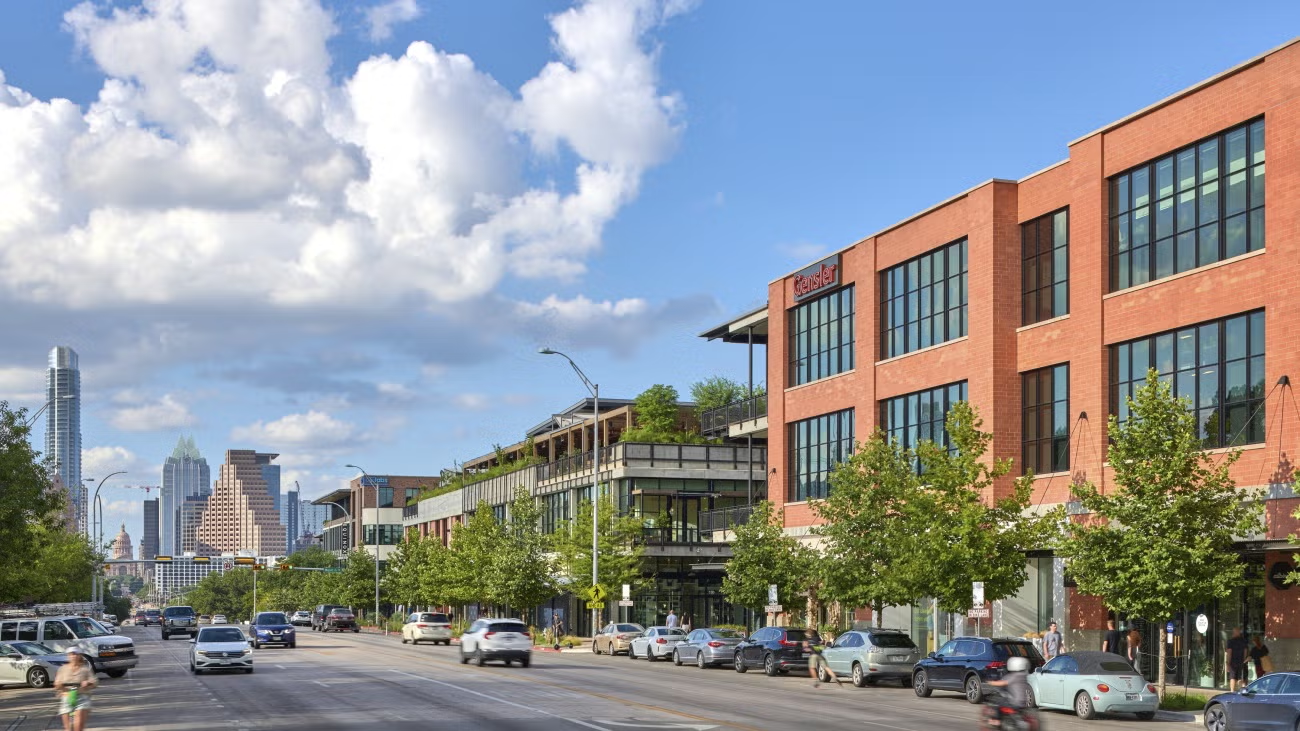
South Congress today: layered ground-floor retail, residential, and office space replacing the corridor's single-use past.
Austin mixed-use development is transforming corridors like South Congress and Burnet Road from single-use commercial strips into layered urban environments combining residential, retail, and office space, reshaping how the city grows. For real estate investors, buyers, and developers, understanding this shift is increasingly essential to navigating Austin's evolving zoning landscape and identifying high-value opportunities.
Drive down South Congress today and it looks nothing like it did ten years ago. The same is true of Burnet Road, East Cesar Chavez, and stretches of North Lamar. What were once straightforward commercial strips, gas stations, auto shops, the occasional diner, have given way to something more layered: apartments above restaurants, office space alongside fitness studios, parking structures tucked behind ground-floor retail. This is Austin's mixed-use shift, and it has been reshaping the city's physical and economic landscape in ways that matter to nearly everyone with a stake in Austin real estate.
The term "mixed-use development" gets used loosely, sometimes to describe any building with a coffee shop on the ground floor. But in practice, it refers to a deliberate planning and development strategy with real implications for zoning, financing, investment returns, and how people actually experience urban life. Understanding what it means in Austin's specific context is increasingly important, whether you are buying a condo, evaluating an investment, or simply trying to make sense of what is being built in your neighborhood.
This article breaks down what mixed-use development actually means, how Austin's regulatory environment shapes it, where it is most active, what it means for investors and residents, and what to watch over the next several years as Project Connect and broader land use reforms continue to drive change across the metro. For the residential counterpart to this corridor story, our overview of Austin infill development explains why the same forces are reshaping single-family blocks a few streets away.
Defining the Model: Vertical, Horizontal, and Everything in Between
Mixed-use development combines two or more distinct land uses, typically residential, commercial, retail, office, or civic, within a single building or across a planned site. The distinction between vertical and horizontal mixed-use is worth understanding clearly, because it affects how projects are built, financed, and evaluated.
Vertical mixed-use stacks uses within a single structure. Think ground-floor restaurant or retail, mid-level office space, and residential units on the upper floors. This model is common in denser urban environments and is increasingly the dominant form along Austin's major corridors where land costs justify building up rather than out.
Horizontal mixed-use distributes different uses across a site or district, with individual buildings dedicated to specific purposes but planned and designed to function as a cohesive environment. Mueller is the clearest Austin example: residential neighborhoods, retail centers, office buildings, parks, and civic uses are all distinct but deliberately integrated into a master plan.
The distinction matters for investors and buyers evaluating specific projects. A vertical mixed-use building in East Austin carries different risk profiles than a horizontal mixed-use district in Round Rock. Financing structures, HOA frameworks, and operating costs differ significantly between the two models.
In Austin, most mixed-use projects contain some combination of the following components:
Ground-floor retail or food and beverage: Street-level activation is a core design and planning goal. Retailers and restaurants anchor pedestrian traffic and support the commercial viability of the project.
Upper-floor residential or office: Multifamily apartments or condominiums are the most common upper-floor use in Austin projects, though office space appears in projects near employment centers or downtown.
Structured parking: Most urban mixed-use projects in Austin include a parking structure, either integrated into the building or as a standalone component on the site. This is a significant cost driver and a frequent point of negotiation in entitlement processes.
Civic or community amenities: Increasingly, Austin mixed-use projects include libraries, community centers, open plazas, or affordable housing components, sometimes as a condition of receiving density bonuses from the city.
What mixed-use is not: it is not simply a coincidence of uses in proximity to one another. A strip mall next to an apartment complex is not mixed-use in any meaningful planning or investment sense. True mixed-use involves intentional integration of uses, supported by zoning entitlements, shared infrastructure, and a coherent design strategy. Understanding highest and best use analysis for a given site is foundational to evaluating whether mixed-use is the right development path.
Austin's Zoning Framework: How Projects Get Approved
Understanding Austin's regulatory environment is essential context for anyone evaluating mixed-use projects here. The City of Austin's Land Development Code governs where and how mixed-use development can occur, and it has been in a state of reform and debate for several years.
Austin uses a tiered system of mixed-use zoning designations, ranging from lower-intensity categories that allow limited commercial uses alongside residential, to higher-intensity designations that permit dense, multi-story development with significant commercial components. The City of Austin's Planning Department is the authoritative source for current zoning designations and their specific parameters, and those designations are worth verifying directly when evaluating any specific site.
Transit Oriented Development overlays, known as TOD zones, are tied to the Project Connect light rail system approved by Austin voters in November 2020. These overlays are designed to concentrate density and mixed-use activity within walking distance of planned rail stations, creating a regulatory framework that actively encourages the kind of development the city wants to see near transit infrastructure.
Beyond base zoning, Austin uses density bonuses as a policy tool. Developers who agree to include affordable housing units, community amenities, or other public benefits can receive entitlements to build taller or at higher density than base zoning would otherwise allow. This system creates a negotiation dynamic between developers and the city, and it affects project timelines, cost structures, and the composition of what ultimately gets built.
The corridors most affected by recent zoning reforms include South Congress, Burnet Road, and North Loop, where changes have unlocked development potential that was previously constrained by older, more restrictive zoning. These are not hypothetical shifts. They are actively influencing where developers are acquiring land and where new projects are entering the entitlement pipeline. Buyers and investors tracking Austin redevelopment opportunities along these corridors will find that zoning reform is a primary driver of where value is being created.
For investors, the entitlement process is one of the most significant risk variables in Austin mixed-use development. A project that looks compelling on paper can face months or years of delay through neighborhood opposition, city review, or legal challenge. Understanding where a project sits in the entitlement process, and what conditions have been placed on its approval, is fundamental due diligence. Our overview of Austin land development opportunities covers this entitlement risk in more depth.
Austin's regulatory environment is more permissive than many older coastal cities, but it is not without friction. The ongoing land use reform process has created uncertainty in some corridors, which represents both risk and opportunity depending on your position and timeline.
The Active Corridors: Where Mixed-Use Is Taking Shape Across Austin
Mixed-use development is not evenly distributed across Austin. It clusters along corridors with transit access, pedestrian activity, and supportive zoning, and it reflects the city's broader growth patterns. Some districts are mature; others are still in transition.
The Domain and North Austin: The Domain is one of the most visible examples of large-scale horizontal mixed-use development in Austin. Located in North Austin near the tech employment corridor along MoPac and 183, it combines major retail, multifamily residential, hotel, and office space in a walkable environment. The surrounding area has continued to densify with additional residential and mixed-use projects as employment growth in North Austin has sustained demand.
East 6th Street and East Cesar Chavez: East Austin has seen some of the most intense mixed-use activity in the city over the past decade. The East 6th corridor in particular has become a dense mix of adaptive reuse projects, new construction, food and beverage, residential, and office. Land values have risen substantially, and the character of development has shifted from small-scale independent projects to larger, more institutional-grade buildings. East Cesar Chavez continues to evolve, with mixed-use projects benefiting from proximity to downtown and improving transit access.
South Congress: South Congress Avenue has long been one of Austin's most recognizable commercial corridors. Zoning reforms and rising land values have accelerated mixed-use development here, with new residential and office projects joining the established retail and restaurant environment. The challenge on South Congress is balancing density with the corridor's existing character, a tension that has produced genuine community debate and shaped the form of approved projects.
The Seaholm District: The Seaholm District, built around the redevelopment of the former Austin Energy Seaholm Power Plant near downtown, is one of Austin's most deliberate mixed-use success stories. It includes the Central Library, residential towers, retail, and open space in a compact, walkable environment. Pricing in Seaholm reflects its maturity and location, and it serves as a useful benchmark for what well-executed urban mixed-use can achieve over time. Buyers evaluating Austin's best neighborhoods for luxury homes will find Seaholm consistently cited for its walkability and urban amenities.
Mueller: Developed by Catellus on the former Robert Mueller Municipal Airport site in Central East Austin, Mueller is the city's most comprehensive example of master-planned horizontal mixed-use development. It includes thousands of residential units across multiple housing types, retail, office, a hospital, parks, and civic uses. Mueller is now largely built out, and its pricing reflects both its quality and its scarcity.
Suburban mixed-use nodes: Outside the urban core, Cedar Park, Round Rock, and Pflugerville are developing mixed-use town center projects designed to serve population growth in the suburbs. These projects tend to be more horizontal in form and more auto-oriented than their urban counterparts, but they reflect genuine demand for walkable, amenity-rich environments even in suburban settings.
Investment Dynamics: Capital, Returns, and Risk in Austin Mixed-Use
The investment thesis behind mixed-use development rests on income diversification. A single property generating rent from residential units, retail tenants, and potentially office or parking creates multiple income streams, which can reduce volatility compared to a single-use asset. In theory, when retail softens, residential income provides a buffer, and vice versa.
In practice, the calculus is more complicated. Austin mixed-use investments carry several distinct risk factors that investors need to understand before committing capital.
Retail vacancy exposure: Ground-floor retail has been a challenging asset class nationally, and Austin is not immune. Finding and retaining quality retail tenants, particularly in projects that are not yet established, requires active leasing effort and sometimes requires accepting below-market rents in the early years of a project's life. Underwriting retail income requires conservative assumptions. Investors looking at the broader picture should review Austin commercial real estate trends for context on retail absorption.
Construction cost escalation: Austin has experienced significant construction cost pressure in recent years, driven by labor availability, materials costs, and supply chain dynamics. Mixed-use projects, which often involve complex structural systems to accommodate different uses in a single building, are particularly exposed to cost overruns. This affects both developer returns and the feasibility of new projects entering the pipeline.
Entitlement uncertainty: As discussed above, the entitlement process in Austin introduces timeline risk that affects financing costs and project returns. Investors in development projects need to price this risk appropriately.
The capital sources active in Austin mixed-use reflect the range of project types and scales. Local developers, often with deep relationships in specific corridors, remain active. Institutional equity has been drawn to larger projects, particularly in established districts with proven demand. Investors tracking institutional capital flows into Austin multifamily will recognize many of the same equity sources now active in mixed-use acquisitions. Family offices, attracted by Austin's growth story and the tax efficiency of real estate, have been active in both development and stabilized acquisitions. Opportunity Zone designations, established under the 2017 Tax Cuts and Jobs Act, have directed additional capital toward mixed-use projects in East Austin and other qualifying areas.
Cap rates and financing structures for mixed-use properties reflect their commercial classification. Even when a project is predominantly residential, a significant commercial component typically means the property is financed as commercial real estate, with different loan-to-value parameters, interest rates, and underwriting requirements than a purely residential asset. Investors building a broader real estate portfolio in Austin should understand how mixed-use assets fit within a diversified capital allocation strategy.
What Buyers and Residents Should Know Before Committing
Buying or renting in a mixed-use building involves considerations that do not apply to purely residential properties. Understanding these before you commit matters, particularly for buyers using conventional financing.
The most significant practical issue for residential buyers is financing. When a mixed-use building contains a meaningful commercial component, Fannie Mae and Freddie Mac guidelines often restrict or preclude conventional mortgage financing. This means buyers may need to pursue portfolio loans, commercial financing structures, or cash purchases. Interest rates and down payment requirements under these structures typically differ from conventional residential mortgages, which affects affordability calculations and buyer pool depth when it comes time to sell. The Austin mortgage rate impact analysis provides additional context on how financing structures move with the broader rate environment.
HOA structures in mixed-use buildings are also more complex than in purely residential communities. Commercial unit owners may be part of the HOA or may operate under a separate commercial condominium structure. Shared costs for common areas, building systems, and parking structures are allocated across both residential and commercial components, and the mechanics of that allocation can be opaque. Buyers should review HOA documents carefully and understand how commercial vacancy or tenant turnover affects the association's financial position.
Noise and access are practical realities in mixed-use buildings. Ground-floor retail or restaurant operations generate activity patterns that differ from residential buildings. Loading dock access, HVAC systems serving commercial spaces, and extended operating hours are all factors that affect residential quality of life. These are not necessarily dealbreakers, but they are knowable in advance and worth evaluating based on the specific building and tenant mix.
On the positive side, the lifestyle case for mixed-use living in Austin is real. Walkability scores in mixed-use districts tend to be among the highest in the city. Access to restaurants, retail, and services without a car trip has genuine value, particularly as Austin's traffic has intensified. Proximity to transit infrastructure, especially as Project Connect buildout progresses, adds another layer of long-term value for residents willing to use it. Buyers relocating from dense urban markets will find this context useful alongside a broader Austin relocation guide that covers neighborhood selection and lifestyle tradeoffs.
The key is going in with clear eyes about what you are buying structurally and legally, not just aesthetically. For a deeper view of how this fits the upper end of the market, see our overview of Austin luxury homes for sale.
Looking Ahead: Rail, Conversions, and the Forces Shaping Austin's Next Phase
Several converging forces will shape Austin mixed-use development over the next several years, and understanding them gives buyers, investors, and residents a meaningful planning advantage.
Project Connect light rail: The Orange Line and Blue Line corridors are the single largest near-term catalyst for mixed-use development activity in Austin. Station area planning is actively underway, and land values along these corridors are beginning to reflect anticipated density. Historically, transit-oriented development around light rail stations has generated significant land value appreciation in the years surrounding station opening, though the timing and magnitude vary by market and project. Investors and developers are already positioning in areas like the South Congress corridor, East Austin station areas, and North Lamar, where TOD overlays and proximity to planned stations create a compelling development environment.
Office-to-residential conversions: Austin's downtown office market has experienced elevated vacancy in recent years, consistent with national trends driven by remote and hybrid work adoption. This has created genuine interest in converting underperforming office buildings into residential or mixed-use properties. Office-to-residential conversion is technically complex and financially demanding, but in a market where downtown residential demand remains strong and office demand has softened, the economics are increasingly worth examining. This is an emerging subcategory of mixed-use activity that will likely produce a meaningful number of projects over the next several years. Developers evaluating these sites will benefit from rigorous Austin infill development analysis before committing to a conversion strategy.
Economic drivers and downside scenarios: Austin's sustained demand for mixed-use environments is underpinned by real economic fundamentals: tech employment, the University of Texas, state government, healthcare, and continued in-migration from higher-cost markets. These are durable demand drivers. That said, a meaningful slowdown in tech hiring or a reversal of migration trends would affect residential absorption in mixed-use projects and retail tenant demand. Investors underwriting Austin mixed-use over a five-to-ten year hold period should stress-test their assumptions against a range of economic scenarios, not just the base case.
The regulatory environment will also continue to evolve. Land use reform in Austin is an ongoing process, and changes to zoning designations, density bonus programs, and affordable housing requirements will affect project feasibility and the competitive landscape for development sites.
Putting It All Together
Mixed-use development is not a trend unique to Austin. It is happening across Sun Belt metros and beyond. But Austin's combination of population growth, employment diversification, an evolving regulatory framework, and major transit investment makes it one of the more active and consequential mixed-use markets in the country right now.
Whether you are evaluating a condo in a mixed-use tower near the future light rail corridor, assessing land along Burnet Road for development potential, or building a portfolio that includes commercial real estate alongside residential, understanding how mixed-use works in Austin gives you a real analytical edge. The distinctions between project types, the nuances of financing, the risk variables in the entitlement process, and the trajectory of specific corridors are all knowable with the right guidance.
Echelon Property Group works across Austin's residential, investment, and land and ranch advisory landscape with a focus on local market intelligence and strategic positioning. If you are trying to make sense of a specific mixed-use project, corridor, or investment opportunity, we are glad to help you think it through.
Learn more about our advisory services and connect with our team for market-specific guidance on Austin mixed-use real estate.
Continue Exploring
Three places to go from here

ABOUT THE AUTHOR
Taylor Sherwood
Austin Real Estate Advisor · Echelon Property Group
Taylor Sherwood is a Certified Luxury Home Marketing Specialist (CLHMS) and top-performing Austin real estate advisor. He specializes in luxury residential properties, land development, commercial real estate, and investment property across Austin and the Texas Hill Country. With deep market expertise and a results-driven approach, Taylor helps buyers, sellers, and investors navigate Austin's most competitive real estate segments.
Related Reading

Cost Segregation and 100% Bonus Depreciation for Austin Investors: The 2026 Playbook
100% bonus depreciation is permanent. What a cost segregation study does on a $1M Austin STR and an 8-unit, who can use the loss, and what recapture costs.
2026-08-26 • 22 min read
Austin ADU Rules in 2026: What HOME Lets You Build, What It Costs, and When the Math Actually Works
Austin ADU rules under the HOME initiative in 2026: what you can build, what it costs, what it rents for, and a worked investor model that shows when the math works.
2026-08-07 • 16 min read

Austin Short-Term Rental Rules in 2026: The Investor's Guide to the New Ordinance, the License Math, and the Shakeout Ahead
Austin rewrote its STR ordinance. License costs, the July 1 platform crackdown, real revenue data from four sources, and a full worked underwrite for investors.
2026-07-31 • 14 min read

Where Austin Homeowners Are Actually Moving in 2026, and How Investors Should Trade It
Travis County just posted its first population decline in over 20 years. County-by-county migration data, the $992/month carrying-cost arbitrage, and four investment theses.
2026-07-28 • 11 min read