Austin Redevelopment Opportunities: How to Identify, Evaluate, and Act on Underutilized Property
Austin redevelopment opportunities are reshaping how landowners, investors, and developers approach underutilized property. This guide covers highest and best use analysis, zoning and entitlements, and the framework experienced advisors use to identify, evaluate, and act on Austin's most compelling redevelopment plays.
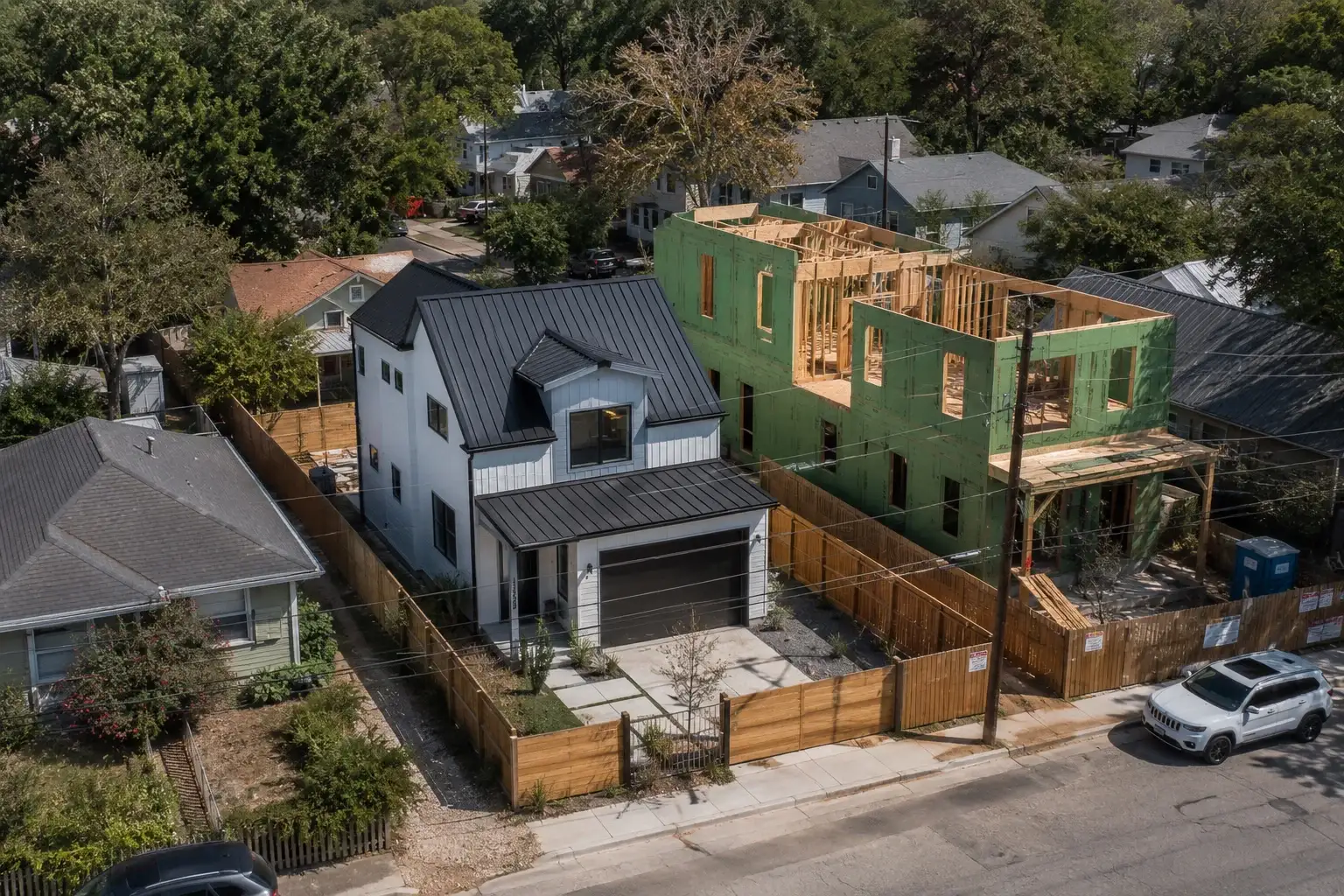
Austin redevelopment opportunities are reshaping how landowners, investors, and developers evaluate underutilized property across neighborhoods such as East Austin, Bouldin Creek, Zilker, Barton Hills, Brentwood, and Crestview. As land values continue to rise and zoning flexibility expands under initiatives like HOME, understanding a property's highest and best use has become increasingly important for owners seeking to maximize value.
This guide is written for landowners, investors, and developers who want to understand how redevelopment opportunities are identified, evaluated, and executed in Austin's current market. Whether you own an aging home on a large lot in Barton Hills, a commercial strip on South Lamar, or a single-family property in East Austin that feels out of place with its surroundings, this guide will help you think through the analysis the way an experienced Austin real estate advisor would.
We cover highest and best use analysis, zoning and entitlement considerations, how investors evaluate sites, common mistakes property owners make, and how to determine whether to hold, sell, or develop. Austin-specific neighborhood context is woven throughout. For the broader market context on why infill has become the dominant reshaping force in central Austin, our companion overview of what Austin infill development is and why it's accelerating is the natural starting point.
The goal is not to push you toward any particular outcome. It is to give you the analytical framework to make a well-informed decision about one of your most significant assets.
Austin Redevelopment by the Numbers
Step 1: Understand What a Redevelopment Opportunity Actually Is
A redevelopment opportunity exists when the land beneath a property is worth more than the property as it currently stands. In practical terms, that means the highest and best use of the site differs from its current use, and that gap represents unrealized value.
Not all redevelopment looks the same. There are four primary types worth understanding:
Teardown and single-family replacement: An older or functionally obsolete home is demolished and replaced with new construction. This is common in Tarrytown, Barton Hills, and Westlake, where lot values have risen well above the contributory value of the existing structure.
Infill multifamily development: A single-family lot or small commercial parcel is redeveloped into a duplex, triplex, fourplex, or small apartment building. Austin's HOME ordinance has significantly expanded this option on SF-3 zoned lots citywide.
Adaptive reuse and commercial repositioning: An older commercial building is repurposed for a higher-value use, whether that means converting a retail strip to office, upgrading a tired strip center, or repositioning a low-density commercial site for mixed-use development. Our work in Austin commercial real estate regularly involves this kind of repositioning analysis.
Lot subdivision: A large lot is divided into two or more parcels, each of which can be sold or developed independently. This strategy is particularly relevant on oversized lots in established neighborhoods like Brentwood and Crestview.
Austin's growth patterns have created redevelopment pressure in specific corridors and neighborhoods for identifiable reasons: proximity to downtown employment, access to major transit corridors, school district quality, and the relative scarcity of developable land inside the city's core. East Austin has experienced some of the most dramatic land value appreciation of any Austin submarket over the past decade, driven by its proximity to downtown and the tech employment corridor along East 6th and East 11th. Bouldin Creek and Zilker have followed a similar trajectory.
The key insight is that redevelopment potential is not just about zoning. It is about market demand, location, and timing. A property may be legally permissible for higher-density use but still fail to pencil as a development project if the market does not support the exit values required. Understanding that distinction is the foundation of everything that follows.
Step 2: Run a Highest and Best Use Analysis
Highest and best use is the foundational concept in redevelopment analysis. It is also one of the most misunderstood. The standard appraisal definition describes it as the legally permissible, physically possible, financially feasible, and maximally productive use of a property. Each component of that four-part test matters. We cover this framework in depth in our guide to determining highest and best use in Austin.
Legally permissible means what current zoning and applicable regulations allow. This includes not just the base zoning classification but also overlay districts, compatibility standards, deed restrictions, and any applicable ordinances like Austin's HOME initiative.
Physically possible accounts for site constraints: lot size, shape, topography, flood plain status, utility access, setbacks, and impervious cover limits. A legally permissible use may not be physically achievable on a particular site.
Financially feasible asks whether the proposed use generates sufficient revenue to justify the cost of development. A use can be legally permissible and physically possible but still fail this test if construction costs exceed what the market will support.
Maximally productive identifies the specific use that generates the highest return among all feasible options. This is where the analysis gets nuanced: sometimes a duplex pencils better than a single-family replacement, and sometimes the reverse is true.
Consider a concrete example. An older single-family home sits on a 12,000 square foot lot in Zilker, zoned SF-3. The structure is aging and contributes limited value. Under Austin's HOME ordinance, the owner may now have the right to build up to three units on that lot without a rezoning. The highest and best use analysis would compare the as-improved value of the existing home against the as-vacant value of the lot developed to its maximum permissible density. If new construction in Zilker supports strong per-square-foot pricing, the land value as a development site may substantially exceed what the existing home would trade for on the open market.
This gap between as-improved value and as-vacant value is where redevelopment opportunity lives. Sellers benefit from understanding it because it affects how they price and market the property. Buyers benefit because it determines what they should pay.
Austin's HOME ordinance, passed in phases beginning in 2023, has materially changed this analysis for thousands of property owners. As of 2025, many SF-3 zoned properties can accommodate up to three units by right, without requiring a rezoning or variance. That policy shift has expanded the universe of financially feasible redevelopment scenarios across the city.
Comparable land sales, entitlement research, and a basic development pro forma are the tools you use to complete this analysis. None of it requires a developer's sophistication to understand at a conceptual level, but getting the numbers right requires careful work and current market knowledge.
Step 3: Read the Zoning and Entitlement Landscape
Zoning is the legal framework that defines what can be built on a given site. The City of Austin Zoning Maps, maintained by the Planning Department, are the authoritative starting point for confirming a property's base classification. The relevant categories for redevelopment include SF-3 (single-family and limited infill), SF-6 (townhouse and condo), MF-1 through MF-6 (multifamily at varying densities), LO and GO (limited and general office), CS (commercial services), MU (mixed use), and PUD (planned unit development). Each carries different development standards, density allowances, and compatibility requirements.
Austin's HOME Initiative changed the SF-3 landscape significantly. Before HOME, SF-3 zoning generally allowed only one principal dwelling unit per lot. After HOME's phased implementation, many SF-3 lots can now accommodate up to three units by right. This is not a minor adjustment. It fundamentally changes the redevelopment calculus for a large portion of Austin's residential land base, and the official program documentation from the City of Austin remains the cleanest source on what each phase actually permits.
Entitlements refer to the approvals, permits, and zoning designations that authorize a specific development on a specific site. A property with existing entitlements, meaning one where the hard work of obtaining approvals has already been completed, commands a premium in the land market. Developers pay for certainty, and entitlements reduce uncertainty.
For properties that are not yet entitled for their highest and best use, the path forward may involve a variance request, a rezoning application, or a compatibility standards analysis routed through the Austin Development Services Department. Austin's compatibility standards restrict building height near single-family zones and are one of the more significant constraints on infill development. Understanding these standards early in the analysis prevents costly surprises.
One of the more sophisticated strategies in Austin's land market is what practitioners call zoning arbitrage: acquiring a property at its current zoning value, pursuing entitlements for a higher-density use, and then selling or developing at the higher-use value. The profit in this approach comes from the entitlement process itself, not just from market appreciation.
The Imagine Austin Comprehensive Plan identifies specific growth corridors and activity centers where higher-density development is encouraged by city policy. These corridors align closely with where redevelopment pressure is most visible. South Lamar, East Cesar Chavez, North Loop, and the Mueller area are all examples of corridors where zoning pressure is active and where rezoning requests are more likely to receive favorable consideration.
A common mistake among property owners is assuming that current zoning is permanent or that rezoning is impossible without exploring the process. In many cases, a straightforward rezoning or a HOME-enabled development scenario is more accessible than owners realize. The first step is always to understand what the current zoning actually permits, not what you assume it permits.
Step 4: Identify the Signs a Property Is Underutilized
Underutilization is not always obvious from the street. The clearest indicators require a combination of site observation and data analysis.
Lot size disproportionate to structure: A 1,200 square foot house on a 10,000 square foot lot in a neighborhood where new construction is averaging 3,000 square feet is a textbook underutilization signal. The land is carrying far more potential than the improvement reflects.
Aging or functionally obsolete improvements: Structures that are outdated in layout, systems, or condition often contribute less value than a developer's pro forma requires. When the cost to renovate approaches or exceeds the cost to replace, the teardown calculus becomes straightforward.
Low price-per-square-foot relative to land value: If a property's total asking price is low relative to what surrounding land is trading for on a per-square-foot basis, the improvement may actually be suppressing value rather than adding it.
Single-story structure on a large urban lot: In high-demand infill neighborhoods, single-story structures on large lots are often among the most compelling redevelopment candidates. The land can support significantly more square footage, and the existing structure adds little to the equation.
Commercial property with below-market rents or vacancy: Older commercial properties operating at below-market rents, or with significant vacancy, often signal that the highest and best use of the site has shifted away from the current use.
Travis Central Appraisal District (TCAD) publishes land and improvement values separately on every parcel record. This data provides a useful starting point for estimating land-to-improvement ratios. When TCAD's land value approaches or exceeds the total assessed value of the property, the improvement is contributing little to the overall valuation, which is a meaningful redevelopment signal. Pairing TCAD data with the City of Austin floodplain maps is also worth the few minutes it takes, since a parcel partially inside a regulated floodplain carries materially different buildable area and entitlement risk than one that is not.
The land-to-value ratio is a quick screening tool investors use to identify candidates worth deeper analysis. A high land-to-value ratio, where land represents a large share of total property value, suggests the improvement is not the primary value driver. That is often where redevelopment economics become compelling. Investors tracking top investment neighborhoods in Austin consistently focus on this metric when screening potential acquisitions.
In Brentwood and Crestview, older ranch-style homes on 7,000 to 10,000 square foot lots have been steadily replaced with new construction as land values have risen. The same dynamic is playing out in Barton Hills, where larger lots and proximity to Barton Springs create strong demand for new construction that older structures cannot satisfy.
Underutilization is always relative to the surrounding market. A property that looks underutilized in East Austin may look appropriately developed in a less supply-constrained submarket. Context matters.
Quick Austin Redevelopment Screening Checklist
A property may warrant a deeper highest-and-best-use analysis if:
- Lot size exceeds neighborhood norms
- Existing structure is more than 30 years old
- TCAD land value exceeds 50% of total assessed value
- Property sits within one mile of a major employment center
- Property is near a major transit corridor
- Current zoning allows additional density
- Comparable redevelopment projects have occurred nearby
- Property receives unsolicited investor or developer offers
- Existing improvements generate below-market returns
- New construction sales are outperforming nearby resale inventory
If three or more conditions apply, the property may justify a formal redevelopment analysis.
Step 5: Evaluate the Redevelopment Economics
Understanding whether a redevelopment opportunity is financially viable requires building a pro forma. This does not need to be complex, but it does need to be honest.
The basic structure of a redevelopment pro forma works as follows: projected exit value minus construction costs, soft costs, financing costs, and required profit margin equals the residual value available to pay for land. This is called the residual land value method, and it is the standard tool developers use to determine what they can afford to pay for a site.
Exit value is the projected sale price or stabilized value of the completed development. In Austin's infill market, this varies significantly by location. New construction in Zilker and Bouldin Creek supports different per-square-foot pricing than new construction in Mueller or Brentwood. Getting this number right is the most important variable in the analysis, and it requires current comparable sales data, not assumptions. Austin Board of REALTORS market statistics are the standard reference for closed-sale activity at the submarket level, and our Austin luxury market analysis and pricing methodology add the per-corridor color those numbers alone do not provide.
Hard construction costs cover the physical work: demolition, site preparation, foundation, framing, mechanical, electrical, plumbing, finishes, and landscaping. These costs have shifted meaningfully in recent years and must be modeled using current contractor pricing, not historical averages. City of Austin building permit data is a useful cross-reference for understanding what is actually being built nearby, at what scale, and how long similar projects have been taking to clear permitting.
Soft costs are frequently underestimated, particularly by first-time developers and property owners who have not been through the entitlement process. Architecture, engineering, civil work, entitlement consulting, permitting fees, and carrying costs during the development period often represent 15 to 25 percent of total project cost. Skipping this line item in a pro forma produces a misleadingly optimistic result.
Financing costs depend on the structure of the deal. Developers using construction loans carry interest expense throughout the build period. Those using equity only still have an opportunity cost to account for. Either way, the cost of capital belongs in the model.
Lot size, setbacks, impervious cover limits, and floor-to-area ratio (FAR) constraints determine how much building can actually be placed on a site. A 10,000 square foot lot may sound generous until you account for required setbacks, tree preservation requirements, and impervious cover limits that reduce the buildable footprint substantially.
Small multifamily projects, including duplexes, triplexes, and cottage courts, pencil differently than single-family replacement. They spread land cost across multiple units, which can improve economics on a per-unit basis. But they also carry more complexity in design, permitting, and eventual sale or management.
The hold versus sell decision deserves careful thought. Sometimes selling land to a developer captures more value than attempting to develop independently, particularly for property owners who lack development experience or access to favorable construction financing. A developer who can execute efficiently may generate a higher residual land value than an inexperienced owner attempting the same project. That residual value is what they will pay you for the land.
Austin Redevelopment Hotspots at a Glance
Step 6: Know Which Austin Neighborhoods Are Under Redevelopment Pressure
Redevelopment activity is not evenly distributed across Austin. Understanding where pressure is concentrated, and why, is essential context for any analysis.
East Austin has been the most active infill redevelopment market in the city over the past decade. Proximity to downtown, the tech employment corridor, and a relatively permissive zoning environment have driven significant teardown-rebuild activity, ADU construction, and small multifamily infill. Land values in East Austin have appreciated substantially, and the pipeline of redevelopment activity remains active.
Bouldin Creek and Zilker consistently rank among the highest-priced infill markets in Austin. New construction on teardown lots in these neighborhoods achieves premium per-square-foot pricing. The combination of SF-3 zoning with HOME ordinance flexibility, strong buyer demand, and proximity to Barton Springs and South Congress makes these among the most compelling redevelopment corridors in the city.
Barton Hills offers larger lots, older housing stock, and proximity to Barton Springs and the Barton Creek Greenbelt. Teardown pressure has been increasing as buyers recognize that the land itself, rather than the existing structure, is the primary value driver. The neighborhood's topography adds site complexity but does not diminish demand.
Clarksville and Tarrytown carry historic character and compatibility constraints that make redevelopment more complex than in other neighborhoods. Land values are among the highest in the city, and single-family teardown and rebuild activity is ongoing. The entitlement process in these neighborhoods requires careful navigation of compatibility standards and, in some cases, historic overlay considerations.
Brentwood and Crestview have emerged as high-activity infill corridors in Central North Austin. Accessible land pricing relative to closer-in neighborhoods, strong new construction demand, and good school access have made these neighborhoods attractive for teardown-rebuild projects and ADU development. The pace of redevelopment activity in these corridors has accelerated noticeably.
South Lamar is an active commercial and mixed-use redevelopment corridor. Rezoning requests and PUD activity along South Lamar reflect the corridor's evolution from low-density retail to higher-density mixed use. Investors and developers tracking Austin development opportunities are paying close attention to this corridor.
Mueller is a planned community with ongoing residential and commercial infill phases managed through a PUD framework. It represents a different type of redevelopment opportunity compared to organic infill neighborhoods. Commercial pads, mixed-use development sites, and residential infill phases are all active within the Mueller master plan.
Westlake and Rollingwood operate under different zoning jurisdictions outside Austin city limits but experience strong custom rebuild demand driven by Eanes ISD school district quality and large lot sizes. The teardown-to-custom-rebuild cycle is well established here, with exit values that support premium construction costs. Zoning flexibility is more limited than inside Austin city limits, but demand remains strong.
The same lot size carries very different redevelopment economics depending on where it is located. A 9,000 square foot lot in Zilker and a 9,000 square foot lot in a less supply-constrained Austin submarket are not comparable development opportunities. Location drives exit value, and exit value drives everything else in the pro forma. A detailed Austin neighborhood review is a useful starting point for understanding how these dynamics differ across submarkets.
Why Market Intelligence Matters Before Redeveloping
Zoning tells you what you can build. Market intelligence tells you whether you should. A site that pencils on paper can still fail in execution if the surrounding submarket cannot absorb the finished product at the price the pro forma assumed.
Before committing to a redevelopment path, the decision should be informed by:
- Buyer demand trends in the target submarket
- Inventory levels for comparable finished product
- Months of supply, as a measure of how balanced the market actually is
- Absorption rates for new construction
- New construction competition already underway nearby
- Price-per-square-foot trends over the last 12 to 24 months
- Migration patterns into and out of Austin, and across submarkets
- Neighborhood appreciation trends relative to the broader metro
Each of these inputs shapes the exit value at the top of the residual land value calculation, and exit value drives every other number below it. Builders who skip this step are not really running a pro forma. They are running a guess.
Our Austin market intelligence resource consolidates the demand, supply, and pricing signals that matter most when evaluating whether redevelopment demand actually exists at a specific corridor or submarket. It is the recommended next step before committing capital to any redevelopment scenario.
Step 7: Navigate Off-Market Acquisitions and the Hold-or-Sell Decision
Most redevelopment land transactions in Austin happen off-market. This is not an accident. Developers and investors prefer direct negotiation for several reasons: privacy, price sensitivity, the ability to move quickly, and the advantage of approaching a seller before competing buyers enter the picture.
Sophisticated developers maintain active prospecting programs in their target neighborhoods. They identify properties that meet their redevelopment criteria, research ownership, and approach owners directly with unsolicited offers. This is standard practice in Austin's infill land market, particularly in high-demand neighborhoods like East Austin, Bouldin Creek, and Barton Hills.
Property owners who receive these approaches without having done their own analysis are at a significant informational disadvantage. The developer has modeled the project. They know what the land is worth to them. The owner often does not have the same information. That asymmetry consistently favors the buyer. Understanding how off-market transactions in Austin are structured is essential before engaging with any unsolicited offer.
Before responding to an unsolicited offer, a property owner should understand: what comparable land sales in the neighborhood have traded for, what entitlement potential the site carries under current and potential future zoning, and what the tax implications of a sale would be, including whether a 1031 exchange is applicable.
The 1031 exchange is a significant consideration for long-term property owners with a low cost basis. It allows the proceeds from a land sale to be reinvested into qualifying replacement properties on a tax-deferred basis. For owners who have held property for many years, the tax savings from a properly structured 1031 exchange can be substantial, and failing to plan for it before a transaction closes forfeits that opportunity permanently.
The hold versus sell decision framework should account for three variables: current income generated by the property, projected future appreciation if held, and the risk and capital requirements of developing independently. For owners who are not developers, selling to an experienced operator often captures more net value than attempting to navigate the development process without relevant experience.
There is also a middle path worth considering: pursuing entitlements before selling. A property owner who invests in the entitlement process, obtaining approvals for a higher-density use before going to market, can often command a meaningfully higher price than an as-is land sale. Developers pay a premium for reduced risk, and approved entitlements represent exactly that.
The most common mistake in this scenario is selling too quickly to the first developer who approaches without understanding what the land is actually worth. A confidential highest-and-best-use consultation before making any decision is the most effective way to close that information gap.
Frequently Asked Questions About Austin Redevelopment Opportunities
What is highest and best use?
Highest and best use is the legally permissible, physically possible, financially feasible, and maximally productive use of a property. It is the standard appraisal framework used to determine what a site is worth as a development opportunity, independent of what currently exists on it. In practice, highest and best use analysis compares the value of a property as it currently stands against its value if redeveloped to its optimal use. The gap between those two values is where redevelopment opportunity lives. Our full guide to highest and best use in Austin walks through the framework in detail.
How do I know if my property has redevelopment potential?
The key indicators to look for include: a lot size that is disproportionately large relative to the existing structure, an aging or functionally obsolete improvement, a high land-to-value ratio as reflected in TCAD data, a location in or adjacent to a neighborhood experiencing active redevelopment activity, and current zoning that permits higher-density use than what currently exists on the site. If your property is in East Austin, Bouldin Creek, Zilker, Barton Hills, Brentwood, Crestview, or along a major Austin corridor, the likelihood of meaningful redevelopment potential is elevated. A formal highest-and-best-use analysis is the most reliable way to move from indicators to conclusions.
Can zoning changes increase property value?
Yes, significantly. Entitlements and rezoning approvals that permit higher-density or higher-value uses directly increase land value by expanding the universe of financially feasible development scenarios. Austin's HOME ordinance is a recent example of policy-driven value creation: properties that were previously limited to a single unit now have the legal right to accommodate up to three units on the same lot, which materially changes their value as development sites. The concept of zoning arbitrage, acquiring land at its current zoning value and selling or developing at a higher-use value after entitlement, is a well-established strategy in Austin's land investment market.
What makes Austin redevelopment opportunities attractive?
Several factors converge to make Austin a compelling market for redevelopment. Population growth has driven sustained demand for housing and commercial space in the city's core neighborhoods. Land scarcity inside Austin's established infill corridors limits new supply, which supports land values. Recent zoning policy changes, including the HOME ordinance, have expanded what is permissible on many residential lots without requiring a rezoning. And Austin's strong employment base, particularly in technology and professional services, supports the exit values that make redevelopment projects financially viable. The combination of demand pressure, constrained supply, and evolving zoning policy creates a durable environment for Austin land investment and infill development.
How does Austin's HOME ordinance affect redevelopment opportunities?
Austin's HOME Initiative reshaped what is permissible on a large share of the city's residential land base. On many SF-3 zoned lots, owners can now build up to three units by right, without going through a rezoning. For redevelopment, that change is significant in two ways. It widens the set of financially feasible scenarios on a given lot, because spreading land cost across multiple units often produces a higher residual land value than a single-family replacement. And it shifts what informed buyers will pay for an underutilized SF-3 parcel, because the legal envelope is larger than it was under prior code. Owners evaluating a property under HOME should confirm the specific phase that applies, the lot's eligibility, and any compatibility or impervious cover constraints that still bind the buildable footprint.
What is a residual land value analysis?
Residual land value analysis is the standard developer framework for deciding what a piece of land is worth as a development site. You start with the projected exit value of the finished project, then subtract hard construction costs, soft costs, financing costs, and a required profit margin. The number left over is the residual, and that is the maximum a rational developer can pay for the land and still hit their return target. Property owners benefit from understanding this calculation because it explains, in plain terms, why developer offers land where they do. A site with strong exit values and reasonable construction costs supports a higher residual, and therefore a higher offer. A site with the same legal entitlements but weaker exit values does not.
Can I sell my property directly to a developer?
Yes, and a meaningful share of Austin land transactions happen exactly this way. Direct sales to developers, often handled off-market, can be faster and more private than a traditional listing, and they avoid much of the staging and showing burden of a retail sale. The risk is informational. Developers come to the table with a fully built pro forma, a clear view of what the land is worth to them, and experience negotiating against owners who do not have the same data. Before engaging directly, the owner should have an independent view of comparable land sales, current entitlement potential, and tax structuring options such as a 1031 exchange. Without those, the developer is the only party in the room with a number.
Should I pursue entitlements before selling?
Sometimes. Pursuing entitlements before going to market can meaningfully increase land value because developers pay a premium for reduced risk and a clearer path to construction. The right answer depends on three things: how large the entitlement-driven uplift is likely to be relative to current as-is land value, how much time and capital the entitlement process will require, and how much execution risk the owner is willing to carry. On corridors where rezoning paths are well established and demand for entitled product is strong, the math often favors entitling first. On parcels where the existing zoning already supports the highest realistic use, additional entitlement work may add cost without proportionally increasing exit value. This is a question worth modeling before committing.
Which Austin neighborhoods are experiencing the most redevelopment activity?
The most active redevelopment corridors in Austin today include East Austin, Bouldin Creek, Zilker, Barton Hills, Clarksville, Tarrytown, Brentwood, Crestview, the South Lamar corridor, Mueller, and the Westlake and Rollingwood submarkets outside Austin city limits. The specific type of redevelopment varies by neighborhood. East Austin sees substantial duplex, triplex, and small multifamily infill. Bouldin Creek and Zilker are dominated by luxury teardown-rebuilds. Brentwood and Crestview are absorbing both single-family replacement and small multifamily under HOME. Westlake and Rollingwood remain almost exclusively custom rebuilds driven by Eanes ISD demand. The common thread is that land value has risen to the point where the existing improvement is no longer the dominant value driver on a meaningful share of parcels.
Request a Confidential Highest-and-Best-Use Consultation
Most property owners know what their property is worth today. Far fewer know what it could be worth under current zoning, redevelopment, or entitlement scenarios. The difference can be substantial.
At Echelon Property Group, we help owners, investors, and developers evaluate redevelopment potential through highest-and-best-use analysis, zoning review, market intelligence, and off-market land valuation.
If you are considering selling, holding, redeveloping, or simply want to understand what your property may be worth to a developer, schedule a confidential consultation.
Echelon Property Group works with property owners, investors, and developers across Austin's most active redevelopment corridors. Our approach is advisory, not transactional. We help clients understand the full value of their asset, the range of options available to them, and the strategic considerations that should inform their decision, before they commit to anything.
If you own property in East Austin, Bouldin Creek, Zilker, Barton Hills, Clarksville, Tarrytown, Brentwood, Crestview, South Lamar, Mueller, Westlake, or Rollingwood, and you are curious about what your property's redevelopment potential might be, we would welcome a private, no-pressure conversation.
There is no obligation and no sales pitch. Just an honest analysis of where your property sits in Austin's current market and what your options look like from here.
Reach out to schedule a confidential highest-and-best-use consultation with the Echelon Property Group.
Continue Exploring
Three places to go from here

ABOUT THE AUTHOR
Taylor Sherwood
Austin Real Estate Advisor · Echelon Property Group
Taylor Sherwood is a Certified Luxury Home Marketing Specialist (CLHMS) and top-performing Austin real estate advisor. He specializes in luxury residential properties, land development, commercial real estate, and investment property across Austin and the Texas Hill Country. With deep market expertise and a results-driven approach, Taylor helps buyers, sellers, and investors navigate Austin's most competitive real estate segments.
Related Reading

Cost Segregation and 100% Bonus Depreciation for Austin Investors: The 2026 Playbook
100% bonus depreciation is permanent. What a cost segregation study does on a $1M Austin STR and an 8-unit, who can use the loss, and what recapture costs.
2026-08-26 • 22 min read
Austin ADU Rules in 2026: What HOME Lets You Build, What It Costs, and When the Math Actually Works
Austin ADU rules under the HOME initiative in 2026: what you can build, what it costs, what it rents for, and a worked investor model that shows when the math works.
2026-08-07 • 16 min read

Austin Short-Term Rental Rules in 2026: The Investor's Guide to the New Ordinance, the License Math, and the Shakeout Ahead
Austin rewrote its STR ordinance. License costs, the July 1 platform crackdown, real revenue data from four sources, and a full worked underwrite for investors.
2026-07-31 • 14 min read

Where Austin Homeowners Are Actually Moving in 2026, and How Investors Should Trade It
Travis County just posted its first population decline in over 20 years. County-by-county migration data, the $992/month carrying-cost arbitrage, and four investment theses.
2026-07-28 • 11 min read