8 Strategies to Buy a Home in Austin's Buyer's Market (Mid-2026 Edition)
Austin has shifted to a buyer's market with 5.3 months of inventory and homes closing 3-4% under list. Eight tactics for negotiating price, structuring seller-paid rate buydowns, using contingencies as leverage, and targeting stale listings while mortgage rates hover near 6.5%.
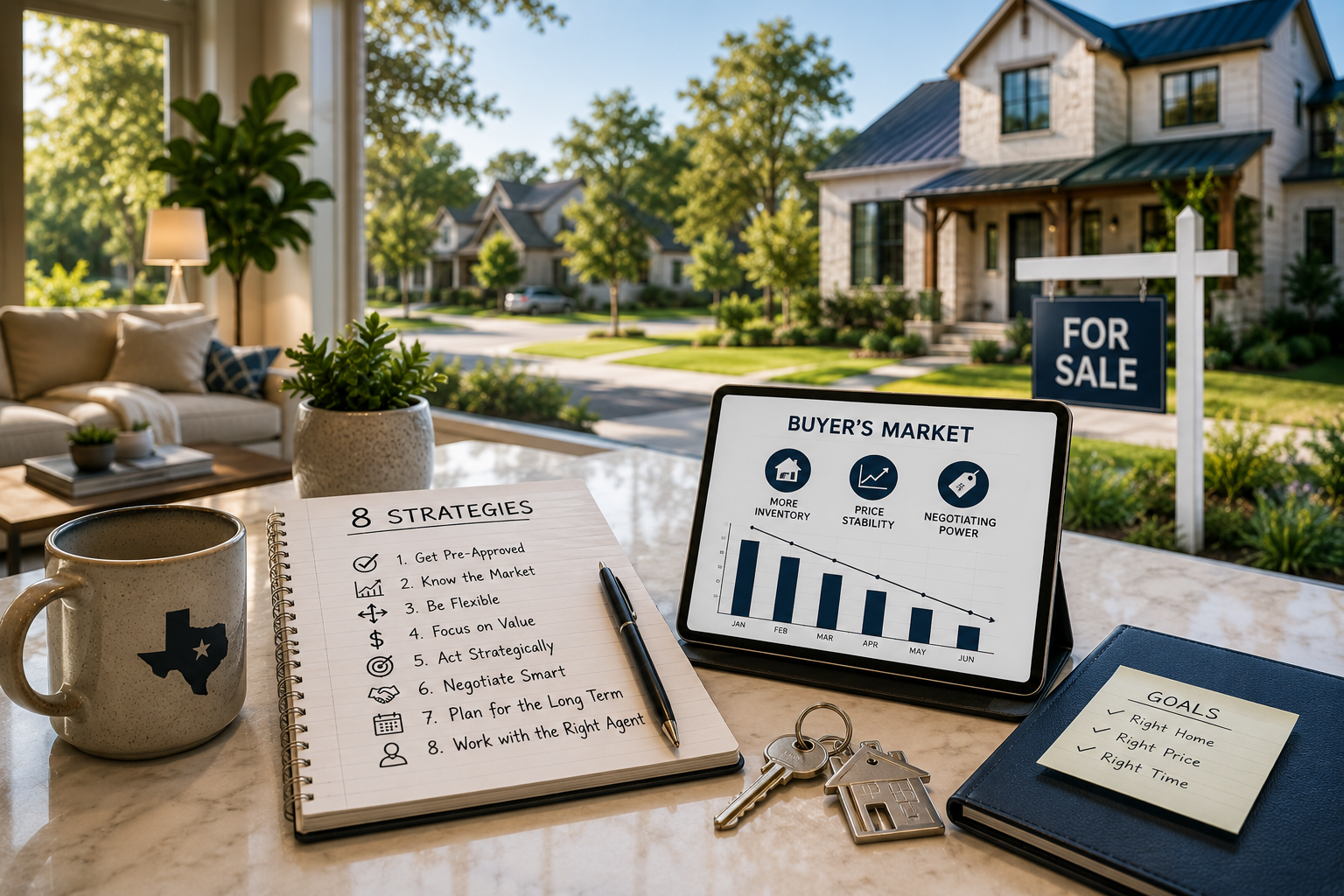
Mid-2026 Austin: more inventory, longer days on market, and motivated sellers, but a 6.5% rate environment that rewards disciplined, well-structured offers.
Austin's real estate market has shifted in buyers' favor, with 5.3 months of inventory, homes closing 3-4% under list price, and sellers under genuine pressure, but navigating how to buy a home in Austin in a buyer's market still requires strategy given mortgage rates hovering near 6.5% and an uncertain Fed outlook. These eight tactics help buyers capitalize on current leverage while managing financing realities in mid-2026.
Austin has shifted. For the first time in years, buyers are holding real leverage, and the market data makes that case clearly. Inventory sits at approximately 5.3 months. Median days on market have stretched to 48, up from 44 a year ago. Roughly 10,700 listings are actively discounting. Homes are closing 3 to 4 percent under list price. And the listing success rate is near 60 percent, meaning roughly 4 in 10 listings expire or withdraw without ever finding a buyer.
Sellers are under genuine pressure. That part is straightforward.
The complication is the rate environment. The 30-year fixed mortgage is running around 6.5 percent as of June 2026, with jumbo loans near 6.7 percent. The Federal Reserve turned hawkish at its June meeting. Inflation came in at 4.2 percent in May 2026, well above the Fed's 2 percent target, and a rate cut this year now looks unlikely. Some forecasters are discussing the possibility of a hike. Most expect rates to stay above 6 percent for years.
Austin's median sale price is approximately $567,000, down roughly 1.5 percent year over year. Appreciation is negative. The "buy now, refinance later" playbook does not hold up when rate relief is not on the horizon. For a deeper look at how these conditions are reshaping the upper end of the market, see the Austin luxury market trends report.
What does work right now is buying right: negotiating aggressively, structuring the deal intelligently, and moving with conviction when the right property appears. These eight strategies are built specifically for Austin buyers navigating these exact conditions.
1. Negotiate Hard on Price. Sub-List Closings Are Now Normal in Austin.
The Challenge It Solves
Many buyers still approach offers with hesitation, worried about offending a seller or losing a deal. That instinct made sense in 2021. It does not make sense now. With 10,700 active price reductions across the Austin market and homes consistently closing 3 to 4 percent below list, anchoring below asking price is not aggressive. It is accurate.
The Strategy Explained
On a $567,000 home, a 3 to 4 percent discount translates to roughly $17,000 to $23,000 off the list price. That is real money, and it is happening on a regular basis across the metro. The sellers with the most room are typically those who have already reduced their price at least once, who have been on market longer than 45 days, or whose original list price was set during a stronger cycle and never adjusted to reflect current conditions.
Identifying overpriced listings requires careful comparable analysis. High-end properties are especially prone to valuation gaps. The piece on high-end home valuation problems covers why luxury pricing is often stickier and where the most significant discounts are being realized.
Implementation Steps
- 01Pull the price history on every property you seriously consider. Any listing with one or more reductions has already signaled seller flexibility.
- 01Run a tight comparable analysis using closed sales from the past 90 days, not list prices. Closed data reflects what buyers are actually paying.
- 01Open with an offer that reflects market reality. A starting position 4 to 6 percent below list on a stale or reduced listing is reasonable and defensible with data.
Pro Tips
Let the data do the negotiating. When you present an offer supported by recent closed comparables, it is harder for a seller to dismiss. Your buyer's agent should be able to walk the listing agent through the logic, not just submit a number. Sellers respond differently when they see that the offer reflects the market rather than an arbitrary lowball.
2. Ask for Seller-Paid Rate Buydowns. They Often Beat a Price Cut.
The Challenge It Solves
At 6.5 percent, monthly payments on a typical Austin purchase are meaningfully higher than they were two years ago. A small price reduction helps, but it often does not move the payment needle as much as buyers expect. The better ask, in many cases, is a seller-funded concession directed toward buying down the rate.
The Strategy Explained
A seller-paid temporary buydown, commonly structured as a 2-1 buydown, reduces the buyer's effective interest rate in the first two years before settling at the note rate. Even a 0.5 to 1 point reduction in the effective rate during the early years of a loan produces meaningful monthly savings that a comparable price cut often cannot replicate on a dollar-for-dollar basis.
Motivated Austin sellers are receptive to this structure because it does not necessarily require them to accept a lower sale price on paper. They contribute cash at closing, the buyer gets payment relief, and the headline price stays intact. It is a negotiating tool that works well when a seller is anchored to a specific number but still needs to close. For buyers new to the Austin market, the guide on how to buy a luxury home in Austin provides useful context on structuring deals effectively.
Implementation Steps
- 01Ask your lender to model the monthly payment difference between a straight purchase at list price versus a purchase with a seller-paid buydown concession. The comparison is often striking.
- 01Structure the concession request as a closing cost credit toward discount points or a temporary buydown, not just a vague "closing cost contribution." Specificity signals that you know what you are doing.
- 01Frame the ask in terms of what it takes to make the deal work at current rates, not as a negotiating tactic. Sellers respond better when the conversation is about financing reality than when it feels adversarial.
Pro Tips
Pair this with a price negotiation rather than choosing one or the other. In a market where sellers are already discounting, asking for both a price reduction and a buydown concession is not unreasonable. The combination can produce a significantly better financial outcome than either approach alone.
3. Use Inspections and Contingencies as Real Leverage Again
The Challenge It Solves
Buyers who entered the market during 2020 to 2022 were routinely advised to waive inspection contingencies, shorten option periods, and remove finance contingencies to compete. That era is over. In mid-2026 Austin, buyers who still approach offers that way are leaving significant protection and negotiating leverage on the table.
The Strategy Explained
The Texas option period gives buyers the right to terminate for any reason during a defined window, typically 7 to 10 days, for a modest fee. This is not just a safety valve. It is a negotiating tool. When an inspection reveals deferred maintenance, mechanical issues, or material defects, buyers can use those findings to renegotiate price, request repairs, or ask for an additional concession rather than simply walking away.
Finance contingencies protect buyers if appraisal comes in low or if loan conditions change. In a market where appreciation is negative and prices are still adjusting, appraisal gaps are a real risk. Including a standard finance contingency is prudent underwriting, not weakness. Buyers who want to understand how the Austin luxury real estate market analysis informs appraisal risk will find useful context there.
Implementation Steps
- 01Include a full option period in every offer. Negotiate the length and fee, but do not waive it. Seven to ten days is standard and reasonable.
- 01Hire an independent inspector with no referral relationship to any party in the transaction. A thorough inspection report is your evidence if you need to renegotiate.
- 01When inspection findings are material, present a specific, documented request. Ask for a price reduction, a repair credit, or both. Sellers who are already motivated to close are more likely to accommodate reasonable requests than to restart the marketing process.
Pro Tips
Do not use the inspection period as a fishing expedition to back out of a deal you never wanted. Sellers and their agents notice patterns. Use contingencies strategically and in good faith, and you will find sellers more willing to work with you when legitimate issues arise.
4. Target Stale Listings and Failed Listings. That Is Where Motivated Sellers Live.
The Challenge It Solves
Most buyers focus on active, freshly listed properties. That is also where competition concentrates. The better opportunity, particularly for buyers who want real negotiating room, is in listings that have been sitting or that have already failed once. These sellers have had time to recalibrate their expectations.
The Strategy Explained
With a listing success rate near 60 percent, roughly 4 in 10 Austin listings expire or withdraw without selling. Those sellers did not disappear. Many of them still want to sell, and they have now experienced firsthand what the market will and will not pay. A buyer who approaches a recently expired or withdrawn listing is often talking to someone who is more motivated and more realistic than a seller who just listed last week.
Stale active listings, properties that have been on market 60 days or longer without going under contract, represent a similar dynamic. The seller has watched other buyers pass, and they know something is not working. This is the environment where off-market conversations happen and where the best deals are structured. For a detailed look at how this connects to private deal flow, see off-market luxury homes in Austin and the overview of private listings Austin buyers actually want.
For buyers who value privacy in the transaction itself, the piece on confidential property transactions explains how these deals are structured discreetly.
Implementation Steps
- 01Ask your agent to pull expired and withdrawn listings from the past 90 to 180 days in your target areas. This is public MLS data, and a good buyer's agent can identify patterns quickly.
- 01For properties that were withdrawn rather than expired, the seller may have pulled the listing to regroup. A direct, professional outreach through your agent can open a conversation before the property relists.
- 01For stale active listings, review the price history and days on market. If the property has been sitting for 60 or more days with no accepted offer, the seller is likely open to a meaningful conversation about terms.
Pro Tips
The best buyer's agents in Austin maintain relationships with listing agents across the market. That network is how off-market and pre-market opportunities surface. When you are working with an agent who has those connections, you are not limited to what is visible on public search portals.
5. Underwrite to Today's Rate. "Date the Rate" Is a Risky Bet Right Now.
The Challenge It Solves
The phrase "date the rate, marry the house" spread widely during the rate spike of 2022 and 2023. The logic was that buyers should purchase now and refinance when rates came down. That logic depended on rates coming down. As of mid-2026, that assumption has not held, and the forward outlook has gotten more difficult, not less.
The Strategy Explained
The Federal Reserve's dual mandate requires it to balance price stability and employment. With inflation at 4.2 percent in May 2026, well above the 2 percent target, the Fed has limited room to cut rates without risking a second inflation wave. The June 2026 meeting reflected a hawkish posture, and some forecasters are now discussing the possibility of a hike rather than a cut. Most expect rates to stay above 6 percent for years.
Buyers who purchased in 2023 or 2024 expecting a near-term refinance to 4 or 5 percent are now carrying a 6.5 percent mortgage with no clear exit. The lesson for mid-2026 buyers is to underwrite the purchase at the current rate and make sure the payment is sustainable at that level, not at a hypothetical future rate. If you cannot make the numbers work at 6.5 percent, the deal does not work. Understanding how valuation interacts with this is worth reviewing in the context of high-end home valuation problems.
Implementation Steps
- 01Run your budget analysis using 6.5 percent for a conforming loan or 6.7 percent for a jumbo. Do not model a lower rate as your base case.
- 01Stress-test the payment at 7 percent. If rates move higher before you close or in the near term after closing, you want to know in advance whether that changes your situation materially.
- 01If the payment at current rates is uncomfortable, that is important information. It may mean adjusting your price range, increasing your down payment, or waiting until your financial position changes rather than hoping rates do.
Pro Tips
A refinance is always a future option if rates do eventually fall. But it is an option, not a plan. Build your purchase decision on what you know today, and treat any future rate improvement as a bonus rather than a requirement. Buyers relocating from out of state will find the guide to buying a luxury home from out of state helpful for navigating these financial decisions remotely.
6. Stop Trying to Time the Bottom. Leverage and Negotiation Beat Waiting.
The Challenge It Solves
Austin's median sale price is down roughly 1.5 percent year over year, and some buyers are holding out for further declines before acting. The reasoning is understandable, but the math does not necessarily support it, particularly for buyers who are ready to transact now and have real negotiating leverage available to them.
The Strategy Explained
The floor of the Austin market correction is not clearly visible. Prices could stabilize, continue to drift, or move differently across submarkets. What is visible and available right now is a market where buyers can negotiate 3 to 4 percent below list, ask for seller-paid concessions, include full contingencies, and target motivated sellers who have been on market for months. That combination of advantages is worth something concrete today.
Waiting for a lower price point carries its own risks. If rates rise further, a 2 to 3 percent decline in purchase price could be offset by a higher monthly payment. If the market stabilizes and seller leverage returns, the negotiating environment changes. And the longer a buyer waits, the longer they are paying rent or carrying another property rather than building equity through paydown.
The math case for acting on current leverage is stronger than the speculative case for waiting. For buyers considering the upper end of the market, the Austin luxury market trends analysis provides additional context on how pricing is moving at different price points.
Implementation Steps
- 01Model two scenarios side by side: buying now with a 3 to 4 percent negotiated discount versus buying six months from now at a hypothetical 2 percent lower price but a potentially higher rate.
- 01Factor in the carrying cost of waiting: rent, transaction costs on an eventual sale of a current property, or opportunity cost of capital sitting idle.
- 01Set a clear decision framework. If you find a property that meets your criteria and can be purchased at a price that works at today's rate, that is the signal to act. Remove "wait and see" as a default position.
Pro Tips
Market timing works in hindsight. In real time, it mostly produces paralysis. The buyers who look back on 2026 as a smart entry point will be the ones who used available leverage rather than waiting for conditions that never arrived exactly as expected.
7. Get Fully Underwritten Pre-Approval and Move Decisively
The Challenge It Solves
Buyer's leverage in a softer market can create a false sense that speed does not matter. It does. Motivated sellers still want to close, and a buyer who appears credible and ready to perform will consistently outperform a buyer who is still getting their financing in order when the right property appears.
The Strategy Explained
There is a meaningful difference between a pre-qualification letter and a fully underwritten pre-approval. Pre-qualification is a preliminary estimate based on self-reported information. Full underwriting means a lender has reviewed your income documentation, tax returns, assets, and credit, and has issued a credit decision subject only to the property appraisal and title. To sellers, that distinction is significant. A fully underwritten approval signals that you are a buyer, not a prospect.
In a market where roughly 4 in 10 listings fail to sell, sellers who do find a serious buyer are motivated to close cleanly. Presenting with a strong pre-approval, a clear offer structure, and a buyer's agent who communicates professionally creates confidence on the other side of the table. That confidence translates into better terms, smoother negotiations, and fewer complications. Understanding the formal structure of buyer representation in Texas is worth reviewing before you start making offers. The overview of the buyer representation agreement in Texas explains what you are signing and why it matters.
Implementation Steps
- 01Contact a lender before you begin seriously touring properties. Provide full documentation upfront and ask specifically for a fully underwritten approval, not a standard pre-qualification.
- 01Keep your financial documentation current. Lenders typically require documents dated within 30 to 60 days. Outdated documentation can delay an approval at a critical moment.
- 01When the right property appears, move quickly on the offer. Buyer's leverage does not mean slow. A well-structured offer submitted promptly signals seriousness. Delay signals hesitation, and hesitation gives sellers a reason to wait for another buyer.
Pro Tips
Discuss your rate lock strategy with your lender before you are under contract. In a volatile rate environment, knowing your options for locking a rate and the associated costs is part of underwriting the deal correctly. Buyers who want to understand how to choose the right professional to guide this process should review the guide on how to choose a luxury real estate advisor in Austin.
8. Widen the Search Across Travis, Williamson, and Hays Counties
The Challenge It Solves
Austin's city core carries a premium that is not always justified by the specific property or the buyer's priorities. Buyers who limit their search to inside the city limits are often paying for the zip code rather than the home, particularly at the mid-range price points where the metro-wide inventory growth has been most significant.
The Strategy Explained
The Austin MSA spans Travis, Williamson, and Hays counties, and each offers distinct trade-offs in price, inventory, schools, and commute. Understanding those trade-offs is part of buying intelligently in this market.
Travis County: Includes Austin proper plus suburbs like Pflugerville, Manor, and Lakeway. The city core commands the highest prices, but outer Travis County areas offer more inventory and more negotiating room at lower price points. Established West Austin neighborhoods such as Westlake Hills, Tarrytown, and Rollingwood remain the most resilient.
Williamson County: Cedar Park, Round Rock, and Georgetown have all seen meaningful inventory growth. These markets offer strong school districts, established infrastructure, and relative value compared to comparable Austin city properties. Georgetown in particular has seen significant new construction, which creates additional buyer leverage. Buyers evaluating new construction options should review the analysis of new construction in Austin and what wins.
Hays County: Kyle, Buda, and Wimberley represent the southwest corridor of the metro. Prices are generally lower than comparable Travis County properties, and the inventory picture has improved. Dripping Springs deserves specific attention for buyers who want proximity to Austin with a different character, particularly at the upper end of the price range.
For buyers focused on the luxury segment, Lake Austin luxury real estate in 2026 and the guide to the best neighborhoods for luxury homes in Austin provide a detailed view of where value is concentrated and where it is not.
Implementation Steps
- 01Define your actual non-negotiables: commute tolerance, school district requirements, and property type. Then map those requirements against inventory across all three counties, not just the city.
- 01Research resale liquidity in any submarket you are seriously considering. Some outer-ring areas have seen strong inventory growth but thinner buyer pools, which affects your exit options down the road.
- 01Ask your agent to run a side-by-side comparison of what a given budget buys in three or four submarkets. The differences are often significant, and seeing them concretely changes the conversation.
Pro Tips
Resale liquidity matters more in a flat or declining market than in an appreciating one. A property in a high-demand submarket with strong school ratings and low days on market will be easier to sell in three to five years than a comparable property in a less established area, even if the latter looks like better value today.
Your Implementation Roadmap
The Austin market in mid-2026 is the most buyer-friendly it has been in years. But buyer-friendly does not mean passive. Rates at 6.5 percent require disciplined underwriting. Negative appreciation requires buying right on price. And motivated sellers require a buyer's agent who knows how to find them and negotiate effectively.
The eight strategies above are not independent. They work together. A fully underwritten pre-approval makes your negotiated offer more credible. Targeting stale and failed listings surfaces the sellers most likely to accept a below-list offer with a buydown concession. Widening your geographic search across the best Austin communities gives you more inventory to apply these tactics against. And underwriting to today's rate keeps the entire process grounded in financial reality rather than optimism.
The buyers who will look back on 2026 as a smart move are the ones who used current leverage rather than waiting for conditions that may never arrive in the form they expected.
Echelon Property Group works as a buyer's advocate in exactly these situations: identifying motivated sellers, surfacing off-market and pre-market opportunities, and structuring offers that capture real value in a market that rewards preparation and precision. For more on how we approach buyer representation, visit the luxury real estate brokerage Austin overview.
If you are serious about buying in Austin or across Central Texas, a strategy conversation is the right starting point. Learn more about our services and reach out when you are ready to move with precision.
Continue Exploring
Three places to go from here

ABOUT THE AUTHOR
Taylor Sherwood
Austin Real Estate Advisor · Echelon Property Group
Taylor Sherwood is a Certified Luxury Home Marketing Specialist (CLHMS) and top-performing Austin real estate advisor. He specializes in luxury residential properties, land development, commercial real estate, and investment property across Austin and the Texas Hill Country. With deep market expertise and a results-driven approach, Taylor helps buyers, sellers, and investors navigate Austin's most competitive real estate segments.
Related Reading

How to Buy a Luxury Home in Austin: 9 Insider Strategies for High-End Buyers
Nine Austin-specific strategies for buying a high-end home above $2M, from neighborhood-by-neighborhood market realities and Lake Austin waterfront nuance to off-market access, pricing logic, and relocation considerations most national guides miss.
2026-06-01 • 20 min read

7 Proven Strategies to Find the Best Luxury Real Estate Agents in Austin
Discover the best luxury real estate agents austin buyers trust. These 7 proven strategies help you find top experts for $2M+ luxury properties today.
2026-05-15 • 12 min read

How to Access Exclusive Home Inventory
How sophisticated buyers actually access exclusive and off-market home inventory in Austin, why the best properties trade quietly, what separates real access from noise, and how to position yourself to see the right homes early.
2026-05-14 • 8 min read

How to Buy a Luxury Home in Austin: The 2026 Buyer's Guide
A step-by-step 2026 guide to buying a luxury home in Austin: off-market access, jumbo financing, buyer representation, neighborhoods, and negotiation backed by current MLS data.
2026-07-18 • 14 min read