Living on Lake Austin: Why Austin's Most Exclusive Waterfront Costs What It Does
Why Lake Austin is Austin's most exclusive address: constant-level water, fixed supply, dock permit scarcity, and waterfront pricing from $4M to $35M+.
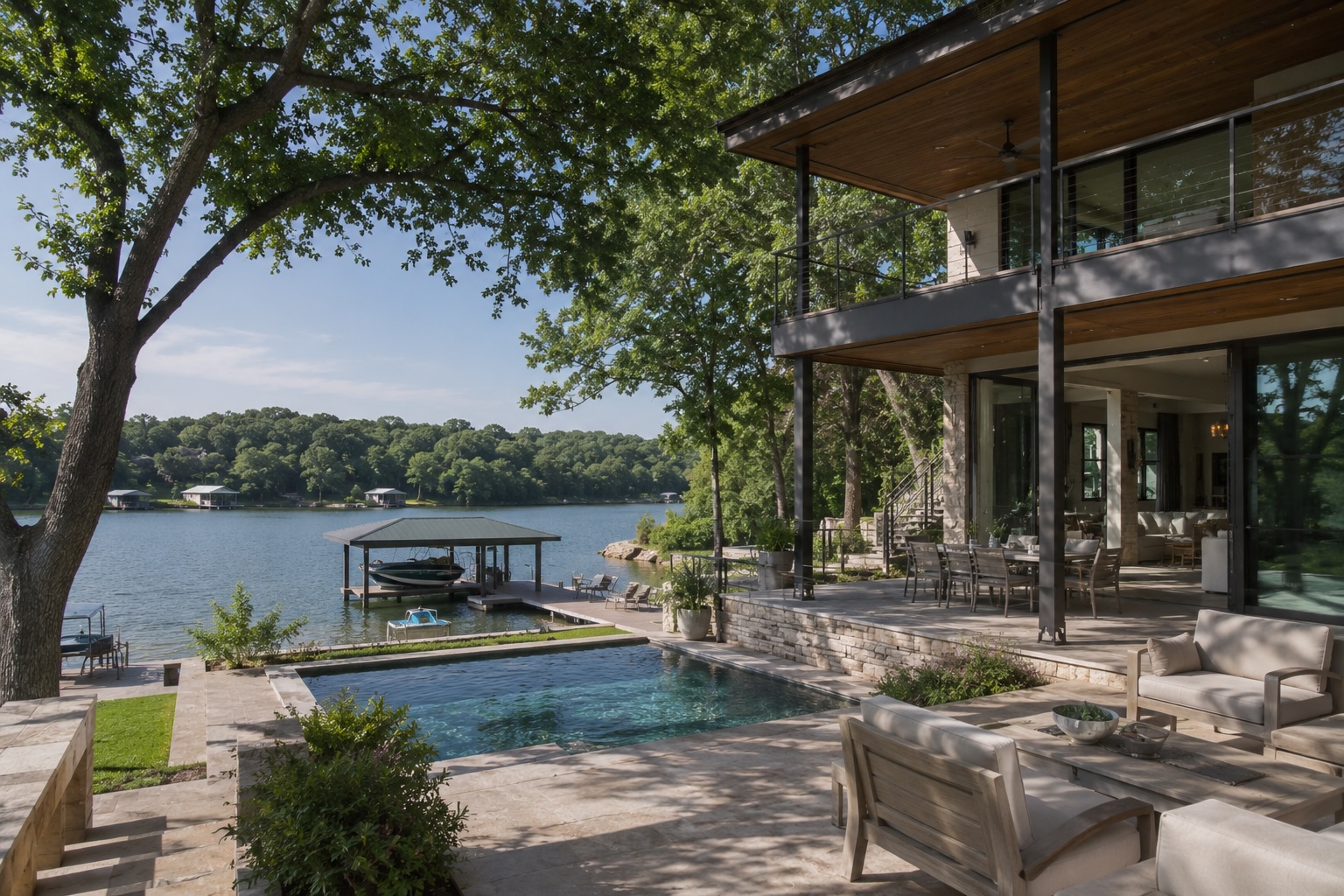
Lake Austin's constant water level and 22 miles of essentially built-out shoreline make direct waterfront one of the most supply-constrained addresses in Texas.
This guide explains what makes living on Lake Austin different from every other waterfront market in Texas, why the price of entry keeps climbing, and how these properties actually change hands, which is often not on the open market.
Lake Austin at a Glance
Lake-view homes and condos (no water access)
- Typical Price Range
- $600K to $1.2M
Entry direct waterfront (older homes, steeper or narrow lots)
- Typical Price Range
- $4M to $5M
Prime waterfront estates (flat lots, modern construction)
- Typical Price Range
- $8M to $15M+
Trophy compounds (acreage, extensive frontage, multiple slips)
- Typical Price Range
- $25M to $35M+
Value on Lake Austin is measured in feet of shoreline as much as square feet of house. Frontage, lot topography, orientation, and dock status frequently matter more to price than the improvements sitting on the land.
What Lake Austin Actually Is
Lake Austin is a 22-mile stretch of the Colorado River between Mansfield Dam and Tom Miller Dam, the last lake in the Highland Lakes chain before the river reaches downtown. It is long, narrow, and lined with limestone cliffs, mature bald cypress, and live oaks growing right to the water's edge.
The single most important fact about it: Lake Austin is a constant-level lake. Water is managed to hold steady year-round, which means the shoreline you buy is the shoreline you keep. Your dock floats in deep water in August of a drought year. Your view never becomes a view of exposed lakebed.
That distinction is everything when you compare it to Lake Travis, the flood-control reservoir immediately upstream, where levels can swing dramatically during extended drought, in severe years by as much as 60 feet. On Travis, a waterfront purchase carries hydrological risk. On Lake Austin, it does not. Buyers pay for that certainty, and the market has priced it in for decades.
The Lifestyle That Drives the Demand
Living on Lake Austin means waterfront life without leaving the city. Most of the lake sits 10 to 25 minutes from downtown, which makes it one of the rare places in the country where you can wakesurf before a board meeting.
The culture is built around the water. Mornings belong to rowers, paddleboarders, and glass-calm ski runs. Summer afternoons bring wakeboats, swim platforms, and coves full of anchored boats. Dinner can happen by water: Ski Shores Cafe and Hula Hut both take boat traffic, and Austin Country Club sits directly on the lake near the Pennybacker Bridge. The scenery holds up on every trip: limestone canyon walls, Mount Bonnell overhead, herons working the cypress roots.
Then there is the practical layer. Much of the south shore feeds into Eanes ISD, one of the top-rated school districts in Texas, which puts family buyers and lifestyle buyers in competition for the same limited shoreline.
Why It Is So Expensive: Five Structural Drivers
1. The supply is fixed and effectively built out. There are 22 miles of shoreline and no mechanism to create more. Most parcels were claimed decades ago. New inventory means an existing owner deciding to sell, and on this lake, owners hold for decades and pass properties through generations. In any given year, only a small number of true waterfront homes trade at all.
2. The constant level removes the biggest risk in lake property. Waterfront that cannot recede is a different asset class from waterfront that can. Lake Austin is the only constant-level lake in the region with this combination of depth, scenery, and city access, so it absorbs the demand of every buyer who has watched Lake Travis shorelines retreat in a drought cycle.
3. Dock permits are scarce and heavily regulated. Shoreline construction on Lake Austin runs through a demanding permitting process, and new dock approvals are difficult to secure. This is why dock-permitted properties carry premiums of 30 to 50 percent over comparable lots without them. An existing permitted dock with deep-water access is not an amenity. It is an entitlement that cannot be reliably replicated.
4. Regulation protects incumbents. Shoreline setbacks, impervious cover limits in the Lake Austin watershed, and City of Austin development rules make new construction slow, expensive, and constrained. Those same rules preserve the character, water quality, and scarcity that existing owners paid for. It is a moat, and it compounds.
5. Location arbitrage that exists almost nowhere else. Globally, deep-water residential frontage within 15 minutes of a major city's core is one of the rarest property types there is. Austin's wealth creation over the past decade has funneled directly into that scarcity. While the broader Austin market cooled from its 2022 peak, Lake Austin waterfront has behaved as its own micro-market, driven by scarcity rather than citywide trends. Spring 2026 asking prices tell the story: a nine-acre estate seeking $15M, a Rockcliff Road property at $19M, and a Westlake Drive listing positioned to set a new public record for the city.
The Exclusivity Layer: Why You May Never See the Best Properties Listed
Here is what surprises buyers most: a meaningful share of Lake Austin waterfront never reaches the MLS. Owners at this level value discretion, and many are willing sellers only at the right number, to the right buyer, without a sign in the yard or photos on the internet. Trades happen through direct relationships, agent-to-agent networks, and quiet outreach long before a listing agreement is ever signed.
This is the segment where Echelon Property Group does the overwhelming majority of its work. Every transaction over $2M we have closed happened entirely off-MLS. On Lake Austin specifically, that means access is the product: knowing which owners will entertain a conversation, what unlisted properties would trade for, and how to structure an approach that a private seller will actually take seriously. If you are only watching public listings, you are seeing a fraction of the real market. Our guides to off-market homes in Austin and how to sell a home privately cover how these transactions work on both sides.
Where People Live on Lake Austin
The lake runs through several distinct corridors, each with its own character.
Old West Austin and Mount Bonnell. Scenic Drive and the Mount Bonnell corridor offer the closest-in waterfront, minutes from Tarrytown and downtown. Established, deeply held, and rarely traded.
The Island and Westlake shoreline. The Island on Westlake is a gated enclave of a few dozen estates, among the most private addresses in the city. The broader Westlake Drive and Rockcliff corridor in 78746 combines Eanes ISD with some of the lake's most significant estates.
Cuernavaca and Davenport Ranch (78733). West of the 360 bridge, larger lots, Hill Country terrain, and Eanes schools. True waterfront here medians around $4M.
Ski Shores and River Hills. The classic lake-culture stretch, where original weekend cabins have steadily given way to significant new construction.
Steiner Ranch and the upper lake (78732). Toward Quinlan Park, master-planned amenities with lake access, marinas, and a lower price of entry than the lower lake, though direct waterfront still commands a heavy premium.
The Honest Trade-Offs
A straight assessment, because polished marketing copy does not close deals with sophisticated buyers. Summer weekends bring heavy boat traffic to the busiest stretches, and the lake is narrow. Property taxes at these valuations are significant, and appraisal growth on waterfront has been aggressive. Docks require maintenance and periodic permitting attention. Some lots carry steep terrain between the house and the water, which is exactly why flat-lot properties command the premiums they do. None of this dampens demand. It simply rewards buyers who evaluate specific properties carefully rather than buying the category.
How to Actually Buy Here
Three things separate successful Lake Austin buyers from frustrated ones. First, get clear on the variables that drive value on this lake specifically: frontage feet, water depth at the dock, lot topography, dock permit status, and orientation. Second, secure representation with genuine off-market access, because the property you end up loving may never be publicly for sale. Third, be ready to move with certainty when the right property surfaces, since sellers at this level choose buyers as much as buyers choose properties. Our guide to buying a luxury home in Austin covers preparation, proof of funds, and negotiation posture in depth.
If Lake Austin is the goal, the conversation starts before the search does. Contact Echelon Property Group to talk through what you are looking for, what it realistically trades for, and what may be available that you cannot see online.
Frequently Asked Questions
Frequently Asked Questions
Why is Lake Austin so expensive?
Lake Austin combines a fixed supply of roughly 22 miles of built-out shoreline with a constant water level, scarce dock permits, top-rated Eanes ISD on much of the south shore, and a location 10 to 25 minutes from downtown Austin. No new waterfront can be created, so rising demand meets permanently limited inventory.
How much does a home on Lake Austin cost?
Lake-view homes and condos without water access run $600K to $1.2M. Direct waterfront starts around $4M to $5M for older homes or challenging lots. Prime flat-lot estates with modern construction run $8M to $15M or more, and trophy compounds with extensive frontage reach $25M to $35M and beyond.
What is the difference between Lake Austin and Lake Travis?
Lake Austin is a constant-level lake, so shorelines, views, and boat access never change. Lake Travis is a flood-control reservoir that can drop dramatically during drought, in severe years by as much as 60 feet. That certainty is a core reason Lake Austin waterfront commands a substantial premium over Lake Travis.
Can you build a new boat dock on Lake Austin?
New dock construction on Lake Austin runs through a demanding, heavily regulated permitting process, and approvals are difficult to secure. That scarcity is why properties with existing permitted docks and deep-water access command premiums of 30 to 50 percent over comparable lots without them.
What neighborhoods are on Lake Austin?
Key corridors include Old West Austin and Mount Bonnell, The Island on Westlake and the Westlake Drive shoreline in 78746, Cuernavaca and Davenport Ranch in 78733, the Ski Shores and River Hills stretch, and Steiner Ranch toward Quinlan Park in 78732. Much of the south shore feeds Eanes ISD.
Are Lake Austin homes sold off-market?
Yes, frequently. A meaningful share of Lake Austin waterfront trades privately through direct relationships and agent networks without ever appearing on the MLS. Owners at this level value discretion, so buyers relying only on public listings see a fraction of the real market. Representation with off-market access matters here more than almost anywhere in Austin.
Continue Exploring
Three places to go from here

ABOUT THE AUTHOR
Taylor Sherwood
Austin Real Estate Advisor · Echelon Property Group
Taylor Sherwood is a Certified Luxury Home Marketing Specialist (CLHMS) and top-performing Austin real estate advisor. He specializes in luxury residential properties, land development, commercial real estate, and investment property across Austin and the Texas Hill Country. With deep market expertise and a results-driven approach, Taylor helps buyers, sellers, and investors navigate Austin's most competitive real estate segments.
Related Reading

7 Smart Strategies for Buying Austin Waterfront Luxury Homes
Austin's waterfront luxury market, spanning Lake Austin, Lake Travis, and the Colorado River corridor, demands a specialized buying approach. The best properties rarely surface on the MLS, and water rights, dock permits, and flood zone classifications shape value more than price per square foot. Seven proven strategies for buying with clarity.
2026-08-04 • 15 min read

Buying Lake Travis Waterfront Property: 7 proven Strategies
How to buy luxury waterfront property on Lake Travis: LCRA dock permits, water levels, off-market access, and 7 strategies from Echelon Property Group.
2026-07-14 • 15 MIN READ

Austin Home Prices by ZIP Code (October 2026)
Median sale price, price per square foot, days on market and inventory for 72 Austin-area ZIP codes, trailing 12 months to Sept 30, 2026. Updated quarterly.
2026-10-16 • 22 min read
The Best Time to Sell a House in Austin: 36 Months of Contract Data, and Why Luxury Runs on a Different Calendar
Three years of Unlock MLS data for Austin and the 78746/78703 luxury core show when buyers sign, when sellers flood in, and the one window that beats spring.
2026-10-12 • 20 min read