Wealth Preservation and Austin Luxury Homes: What the Engel & Völkers Private Office Report 2026/27 Means for You
Wealth preservation real estate outweighed lifestyle in 37% of luxury deals, per Engel & Völkers' 2026/27 Private Office Report. What it means for Austin.
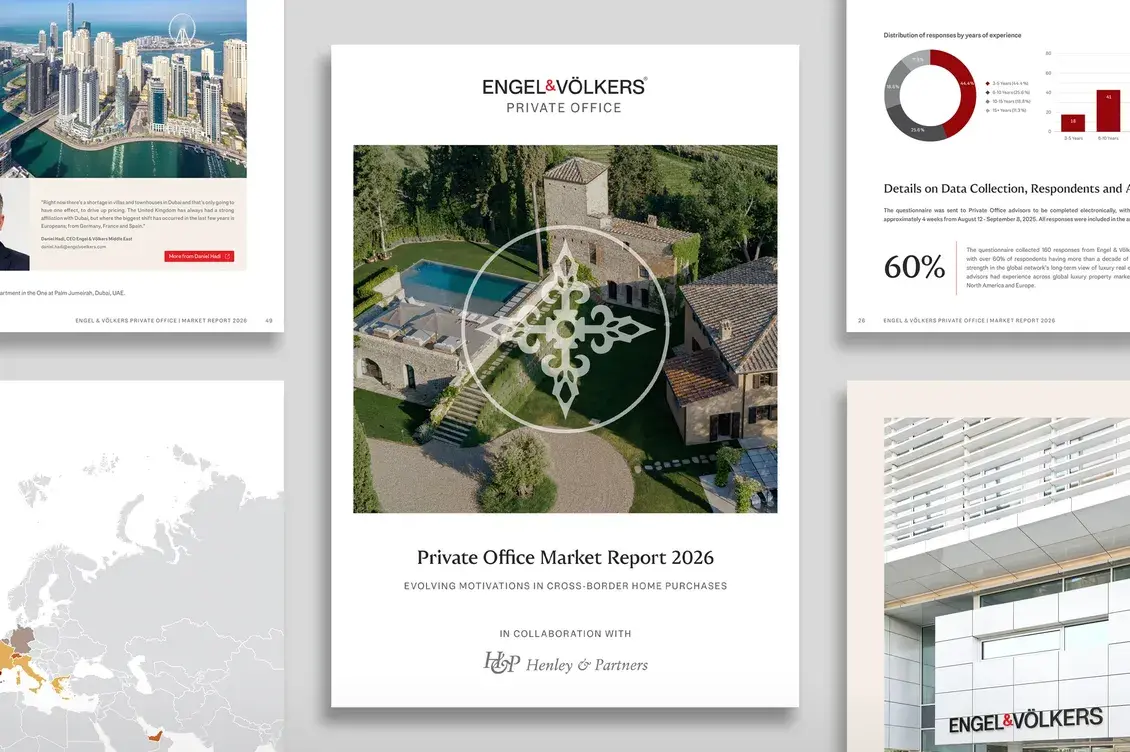
Engel & Völkers Private Office report photography. © Engel & Völkers. All rights reserved.
Short answer: Luxury buyers still say they buy for lifestyle, but wealth preservation was the stronger motive in an average of 37% of transactions, according to the Engel & Völkers Private Office Market Report 2026/27. For Austin, that means buyers should judge a home as a long-term family asset, and sellers should market to that motive.
Every year I read the global research our brand publishes, then ask one question: what does it change for my clients here in Austin? This year's answer is bigger than usual. The report puts words to something I see in almost every high-end conversation. People talk about the view and the pool. Then they ask about taxes, privacy and who will own the house in 20 years.
For the title-planning side of a family property purchase, our Texas LLC vs. trust guide compares privacy, homestead eligibility, lending and estate-planning considerations.
Key takeaways
- Preservation runs under the surface. Only 18.9% of advisors said clients frame property as a preservation asset, yet preservation was the stronger motive in 37.4% of deals, per the report.
- Caution is the global mood. 70% of advisors say clients have become more cautious amid global uncertainty, per Engel & Völkers.
- Taxes now weigh almost as much as lifestyle. Lifestyle was cited by 34% of advisors, and geopolitical instability and tax or regulatory change by 30% each, per the report.
- Heirs are at the table. The next generation materially influences 24% of transactions, and preservation rises to 55% where heirs influence a majority of decisions, per the report.
- The U.S. is a domestic, rate-sensitive market. U.S. advisors reported the heaviest interest-rate effect of any market (net -1.05) and a 33% preservation share, per the report.
- Texas has structural advantages. The Texas Constitution prohibits a personal income tax and, since 2025, state estate and inheritance taxes.
What is the Engel & Völkers Private Office Market Report 2026/27?
The Private Office Market Report is Engel & Völkers' annual study of the top tier of the global luxury market. The 2026/27 edition was produced with Henley & Partners, the residence and citizenship planning firm, per Engel & Völkers.
The research surveyed 185 Private Office advisors across 17 countries between May and July 2026. The questionnaire had 45 questions across eight sections, and advisors averaged 12.3 years of luxury experience, per the report's research approach.
The report measures what advisors observe, not closed-sale prices. Many questions use a net score from -2 to +2, where zero means no change. I keep that in mind when I translate it to Austin.
Advisors surveyed
- Figure
- 185
- Source
- Report, p. 24
Countries covered
- Figure
- 17
- Source
- Report, p. 24
Survey window
- Figure
- May to July 2026
- Source
- Report, p. 24
U.S. advisors in the panel
- Figure
- 80 of 185
- Source
- Report, p. 59
Research partner
- Figure
- Henley & Partners
- Source
- Engel & Völkers
Why do luxury buyers say "lifestyle" but act on wealth preservation?
The report's central finding is a gap between what clients say and what drives the deal. Asked how clients position property, 62.7% of advisors described it as a lifestyle and quality-of-life decision. Only 18.9% said long-term capital preservation, and 1.1% said rental yield, per the report.
Asked what actually drove each transaction, the same advisors said wealth preservation was the stronger motive in 37.4% of cases. The report calls that "very nearly double" the stated figure, per page 31.
I see the same pattern in Austin. A buyer falls for a Westlake view, then spends the next meeting on property taxes, title and how the house fits the family's plans. Both motives are real. A good advisor plans for both.
Property described as a lifestyle decision
- Share
- 62.7% of advisors
- Source
- Report, p. 30
Property described as long-term preservation
- Share
- 18.9% of advisors
- Source
- Report, p. 30
Property bought for rental yield
- Share
- 1.1% of advisors
- Source
- Report, p. 30
Preservation was the stronger motive
- Share
- 37.4% of transactions
- Source
- Report, p. 31
What is driving high-net-worth buyers in 2026?
Personal preference still leads, but outside pressures are close behind. Lifestyle was cited by 34% of advisors as a factor shaping client decisions. Geopolitical instability and tax or regulatory change followed at 30% each, per the report. Personal security and privacy, and inflation, ranked next.
The behavioral result is caution. 70% of advisors reported more cautious clients, against roughly 11% describing more opportunistic ones, per page 33. Clients are taking more time, asking for more information and leaning harder on advisors.
U.S. advisors named tax and regulatory change most often, ahead of personal security and privacy, per the report's U.S. profile. That ranking matters in Texas, where the tax picture is unusual.
How do Texas tax and homestead rules fit a wealth-preservation strategy?
Texas answers several of the questions the report says buyers are quietly asking. I am not a tax attorney or CPA, so treat this as a starting list for your advisors.
- No personal income tax. Article 8, Section 24-a of the Texas Constitution says the legislature may not tax the net incomes of individuals.
- No state estate or inheritance tax. Texas voters adopted Proposition 8 on November 4, 2025, adding Article 8, Section 26, which bars state estate, inheritance and death taxes, per the Texas Legislative Reference Library.
- Strong homestead protection. A Texas homestead is exempt from seizure for most creditor claims, with listed exceptions such as purchase money, property taxes and qualifying liens, under Property Code Section 41.001.
- The trade-off is property tax. Texas has no state property tax, but local taxing units assess it, per the Texas Comptroller. School districts must provide a $140,000 residence homestead exemption.
Texas homestead protection is defined by acreage, not dollar value. That is a real difference for estate-level homes.
Urban home (city limits, ETJ or platted subdivision with services)
- Size limit
- Up to 10 acres
- Source
- Property Code 41.002
Rural home, family
- Size limit
- Up to 200 acres
- Source
- Property Code 41.002
Rural home, single adult
- Size limit
- Up to 100 acres
- Source
- Property Code 41.002
Sale proceeds from a homestead
- Size limit
- Protected for 6 months after the sale
- Source
- Property Code 41.001(c)
Property taxes are where Austin owners feel the cost. I walk through the details in my guides to Austin property taxes and the 2026 Texas homestead exemption.
Are luxury buyers paying cash or financing in 2026?
Mostly, nothing has changed, and where it has, it tilts toward cash. 114 of 185 advisors reported no material change in how deals are funded. 49 described a shift from financing to cash, against 22 describing the reverse, per the report.
Interest rates are a headwind, and the U.S. feels it most. The global rate effect scored net -0.65, and the U.S. scored net -1.05, per page 43. Nationally, Freddie Mac's 30-year fixed average was 7.11% as of November 12, 2026, up from 6.24% a year earlier, per Freddie Mac PMMS.
One San Francisco advisor quoted in the report said many clients prefer to borrow against an investment portfolio rather than take a traditional purchase loan. Whether that suits you is a question for your wealth manager and lender. I explain how rates move Austin pricing in how mortgage rates affect Austin.
Crypto is not the story yet. 130 of 185 advisors reported no crypto-settled activity and none expected within 24 months. Only 10 had seen any, per page 43.
How does the U.S. luxury market compare with the rest of the world?
The report describes a two-speed market. Southern Europe and Switzerland look confident, while North America and Germany look measured, per page 36. The U.S. is still rising on balance, but under rate pressure.
Prices
- Net score or share
- +0.29
- What it means
- Rising on balance
Foreign interest
- Net score or share
- -0.04
- What it means
- Steady
Client confidence
- Net score or share
- -0.99
- What it means
- Measured, in line with the global mood
Interest rates
- Net score or share
- -1.05
- What it means
- Heaviest rate effect of any market
Preservation share
- Net score or share
- 33% of transactions
- What it means
- One deal in three
Lifestyle buyers
- Net score or share
- 70%
- What it means
- Firmly a lifestyle market
*Source: Engel & Völkers Private Office Market Report 2026/27, p. 60. Net scores run from -2 to +2.*
U.S. demand is mostly domestic. Only around 7% of enquiries originate abroad for the typical U.S. advisor, led by Canada and Mexico, then the United Kingdom, per the same page. Globally, the report says current price gains are being sustained by domestic demand rather than foreign capital, per page 28.
That fits what I see in Austin, where most of my luxury buyers are already U.S.-based, often relocating from another state. If that is you, my California to Austin guide covers the practical side.
What does the Austin housing market look like right now?
The broad Austin market is soft on volume and steady on price inside the city. These are all-price-range figures, not luxury-only figures.
City of Austin
- Homes sold
- 704 (down 14.6%)
- Median price
- $550,000 (flat)
- Months of inventory
- 5.7
Travis County
- Homes sold
- 958 (down 13.2%)
- Median price
- $480,000 (down 4.9%)
- Months of inventory
- 6.2
Austin-Round Rock-San Marcos MSA
- Homes sold
- 2,114 (down 11.4%)
- Median price
- $404,802 (down 6.9%)
- Months of inventory
- 6.2
*Source: Unlock MLS, October 2026 Central Texas Housing Report, released November 11, 2026. Changes compare with October 2025.*
Unlock MLS attributed the metro median decline to lower-priced homes making up a larger share of sales. Its president said softer prices may give buyers more negotiating room, per the report release.
My read: a careful, preservation-minded buyer has time to do real diligence in Austin today. A seller needs a price and a story that hold up to that diligence.
How is generational wealth transfer changing what luxury buyers want?
Heirs are increasingly part of the decision. Advisors say the next generation materially influences 24% of transactions on average, per the report. When heirs are involved, the time horizon gets longer.
That shift changes the motive. Where heirs influence about half of decisions, preservation is the primary motive in 49% of transactions. Where they influence a majority, it reaches 55%, per page 38.
The next generation also wants different things. 43% of advisors cite a stronger pull toward hobby and passion-led property, such as ski access, vineyards, equestrian facilities or boating, per page 39. Multigenerational living capacity was cited by 19%, per page 40.
Around Austin, that passion list maps to Lake Austin and Lake Travis waterfront, Hill Country acreage and equestrian land. My Hill Country ranch market guide is a good next read.
Hobby and passion-led properties
- Share of advisors
- 43%
- Source
- Report, p. 39
Multigenerational living capacity
- Share of advisors
- 19%
- Source
- Report, p. 40
Different geographic preferences
- Share of advisors
- 18%
- Source
- Report, p. 40
Wellness and health amenities
- Share of advisors
- 16%
- Source
- Report, p. 40
Branded residences and turn-key product
- Share of advisors
- 15%
- Source
- Report, p. 40
Technology and smart-home integration
- Share of advisors
- 12%
- Source
- Report, p. 40
Who is the typical luxury buyer, according to the report?
The typical buyer is established, not newly wealthy. Seven in ten advisors named the 50 to 65 age group as typical, and fewer than one in twenty named buyers under 35, per page 46. U.S. advisors describe a clientele weighted toward the older group.
Portfolios are simpler than the word "ultra-prime" suggests. 41% of advisors said the typical client owns a primary home plus one second or holiday home. On average, 28% of clients own homes in more than one country, per page 47. Formal family offices and trusts remain the exception.
What should Austin luxury buyers do with these findings?
Buy for the life you want, and underwrite it like a family asset. Here is the checklist I use with clients.
- 01Name both motives early. Tell me the lifestyle goal and the 10 to 20 year goal. They often point to different neighborhoods.
- 02Bring in your team before you write an offer. Advisors in the report most often engage finance, legal and tax partners around a deal, per page 44. Do the same.
- 03Decide how you will hold title. A trust or entity can serve privacy and estate goals, but it can affect the homestead exemption. Ask your attorney first.
- 04Model the property tax, not just the price. Texas trades no income tax for real local property taxes.
- 05Check the acreage against homestead rules. Urban and rural limits differ under Property Code 41.002.
- 06Plan for the next generation's use. Guest quarters, water access and land can widen long-term appeal.
If you are building a broader holding, my post on building a luxury real estate portfolio in Austin goes deeper.
What should Austin luxury sellers do with these findings?
Market to the motive buyers do not say out loud. A preservation-minded buyer wants proof that the home holds value and is easy to own.
- Lead with durability. Highlight build quality, recent systems work, land and location fundamentals.
- Have the paperwork ready. Survey, tax history, HOA documents and permits shorten diligence for cautious buyers.
- Respect privacy. Discretion is a selling point for this buyer, and I cover how to protect it in privacy concerns when selling a high-value home.
- Price for a patient market. With 5.7 months of inventory in the city of Austin in October, per Unlock MLS, buyers can compare.
My full process is in how to sell a luxury home in Austin.
Frequently Asked Questions
What is the Engel & Völkers Private Office Market Report?
The Private Office Market Report is an annual Engel & Völkers study of the top tier of the luxury market. The 2026/27 edition, produced with Henley & Partners, surveyed 185 Private Office advisors in 17 countries between May and July 2026 about wealth preservation, generational transition and global uncertainty.
What percentage of luxury purchases are driven by wealth preservation?
Advisors in the Engel & Völkers Private Office Market Report 2026/27 said wealth preservation was a stronger motive than lifestyle or practical use in 37.4% of transactions on average. Only 18.9% of advisors said clients openly describe property as a long-term preservation asset.
Are luxury buyers more cautious in 2026?
Yes. In the Engel & Völkers Private Office Market Report 2026/27, 70% of advisors said clients had become more cautious amid global uncertainty, taking more time to evaluate options. Roughly 11% described clients as more opportunistic, giving a net score of -0.83 on the report's scale.
Does Texas have an estate or inheritance tax?
No. Texas voters adopted Proposition 8 on November 4, 2025, adding Article 8, Section 26 to the Texas Constitution. It prohibits the legislature from imposing state estate, inheritance or death taxes. Federal estate tax rules still apply, so confirm your situation with an estate attorney.
How much land does the Texas homestead protect?
Under Texas Property Code Section 41.002, an urban homestead can include up to 10 acres. A rural homestead can include up to 200 acres for a family or up to 100 acres for a single adult. The protection is set by acreage, not by the dollar value of the home.
Is the luxury market in Austin driven by foreign buyers?
The report suggests not. U.S. advisors said only around 7% of enquiries come from abroad for the typical advisor, led by Canada and Mexico. Globally, the report found price gains are being sustained by domestic demand rather than foreign capital, which matches what I see in Austin.
How does generational wealth transfer affect luxury real estate?
The report found heirs materially influence 24% of luxury transactions. Where heirs influence a majority of decisions, wealth preservation becomes the primary motive in 55% of deals. Families plan on longer horizons and favor homes with multigenerational space and passion features like water, land or equestrian use.
Sources
- Engel & Völkers Private Office Market Report 2026/27 (digital edition, Precision Media Group)
- Engel & Völkers Private Office: Market Report 2026/27 overview
- Texas Constitution, Article 8, Section 24-a: Individual income tax prohibited
- Texas Legislative Reference Library: Proposition 8 (2025), adds Article 8, Section 26
- Texas Property Code, Chapter 41: Interests in land (homestead)
- Texas Comptroller: Property tax exemptions
- Unlock MLS: October 2026 Central Texas Housing Report
- Freddie Mac: Primary Mortgage Market Survey
Want to plan a purchase or sale around your long-term goals?
I am not a tax advisor, attorney or wealth manager, and nothing here replaces their advice. What I do is help you find, price and negotiate the right Austin home while your team handles the structure. Engel & Völkers' global network is one reason I chose the brand, as I explain in why Engel & Völkers. If you are weighing a move in Westlake, Lake Austin, Barton Creek or the Hill Country, reach out for a private consult.
About the author
Taylor Sherwood, REALTOR®, CLHMS, ABR, GRI, is the founder of Echelon Property Group, brokered by Engel & Völkers Austin. He advises buyers, sellers and investors on luxury homes, land and investment property across Austin and the Texas Hill Country, and is licensed in Texas and Tennessee. More about Taylor.
Echelon Property Group | Engel & Völkers Austin, 3700 Bee Caves Rd STE 102, Austin, TX 78746
Continue Exploring
Three places to go from here

ABOUT THE AUTHOR
Taylor Sherwood
Austin Real Estate Advisor · Echelon Property Group
Taylor Sherwood is a Certified Luxury Home Marketing Specialist (CLHMS) and top-performing Austin real estate advisor. He specializes in luxury residential properties, land development, commercial real estate, and investment property across Austin and the Texas Hill Country. With deep market expertise and a results-driven approach, Taylor helps buyers, sellers, and investors navigate Austin's most competitive real estate segments.
Related Reading
Wealth Building Through Luxury Real Estate
How affluent buyers and investors compound capital through scarcity, off-market access, and disciplined micro-market judgment, why the best luxury acquisitions protect capital, create optionality, and reward selectivity over time.
2026-05-02 • 9 min read
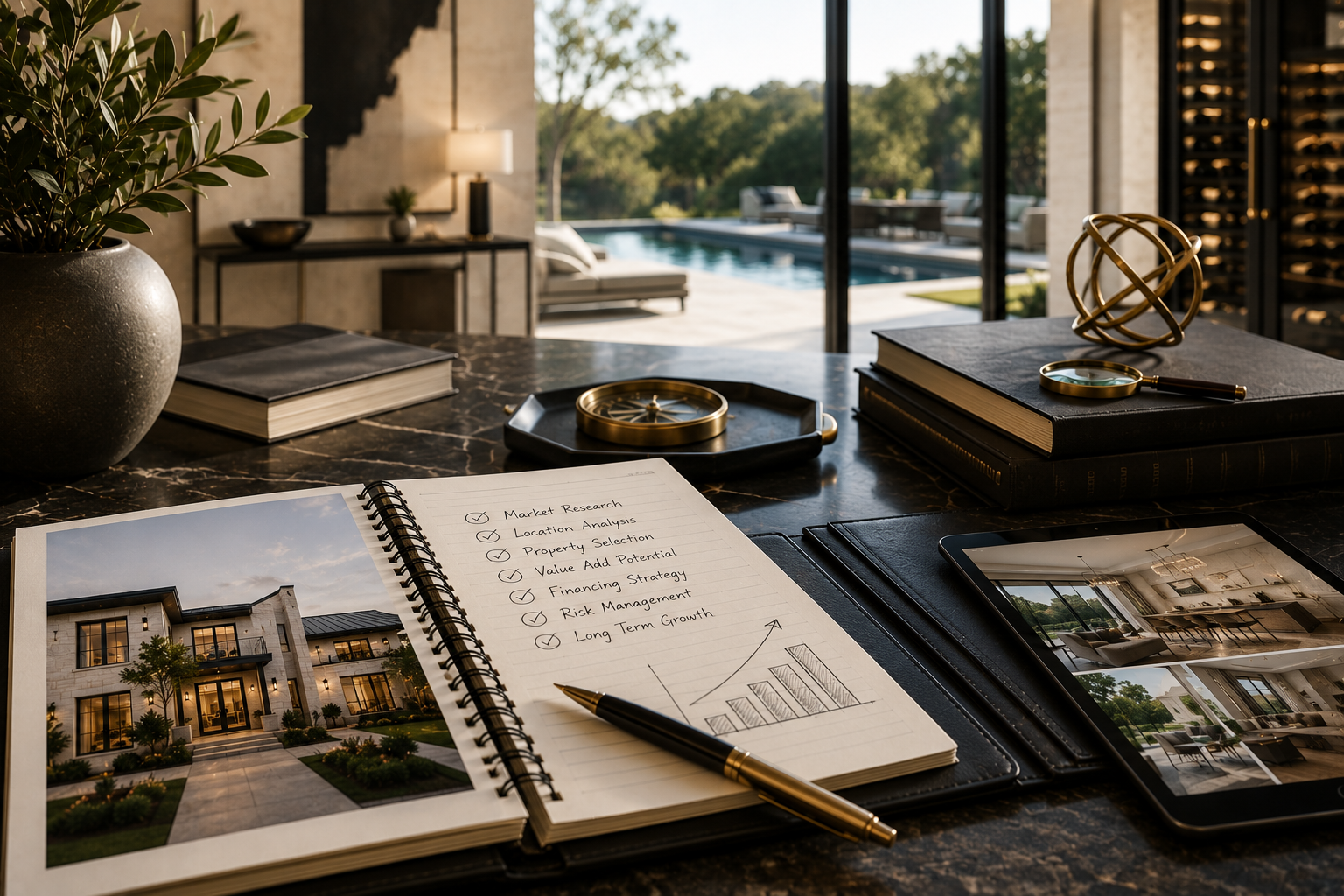
7 Proven Strategies to Build a Luxury Real Estate Portfolio in Austin
A concrete, Austin-specific framework for building a luxury real estate portfolio across Travis, Williamson, and Hays counties, covering asset mix, neighborhood fundamentals, leverage, 1031 exchanges, off-market acquisition, Hill Country land, and advisor selection.
2026-06-21 • 18 min read
Texas Homestead Exemption 2026: The New $140,000 Rules, What They Actually Save in Austin, and the Cap That Dies in December
The Texas homestead exemption jumped to $140,000 in November 2025 ($200,000 at 65+). Full Austin entity-by-entity math, worked examples at $650K and $2.5M, the two-year refund window, and the investor cap expiring December 31, 2026.
2026-08-20 • 17 min read
Austin Housing Market Forecast 2027: What the Data Says Happens Next
Austin's 2027 housing forecast: prices, mortgage rates, inventory and sales by price tier, three rate scenarios, and the Unlock MLS data behind each call.
2026-09-22 • 35 min read